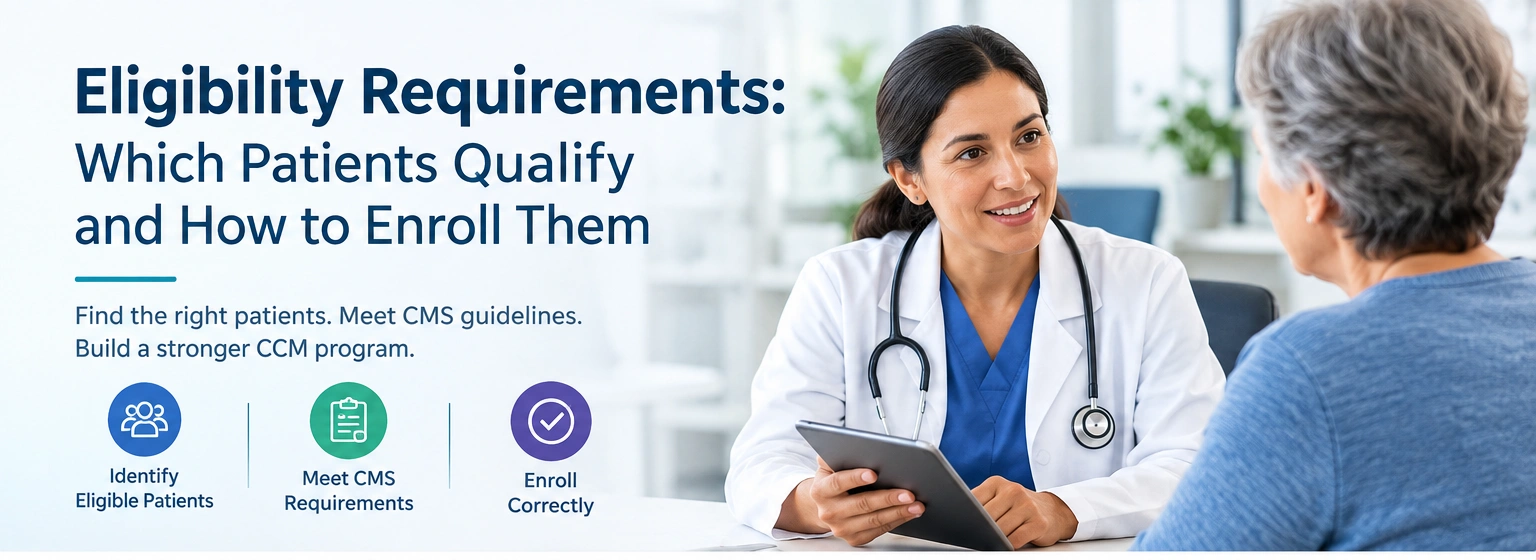
A patient qualifies for Chronic Care Management (CCM) when they have two or more chronic conditions that are expected to last at least 12 months, or until the patient’s death, and those conditions place the patient at significant risk of death, acute exacerbation or decompensation, or functional decline. That is the core CMS eligibility standard. In practice, though, deciding who to enroll takes more judgment than a checklist, and getting the enrollment conversation right matters just as much as the clinical criteria.
Chronic care management software is the foundation of a well-run CCM program.
This guide covers which patients commonly qualify for chronic care management software programs, what doesn’t count toward eligibility, and how the enrollment and consent process should work once a qualifying patient has been identified. For background on the program itself, see our guide to what Chronic Care Management is.
Choosing the right chronic care management software affects every part of the workflow described above.
The Core CCM Eligibility Standard
CMS eligibility for chronic care management rests on three conditions being true at the same time: the patient has two or more chronic conditions, those conditions are expected to persist for at least a year or for the remainder of the patient’s life, and the conditions carry meaningful clinical risk if left unmanaged between visits. A patient with a single, well-controlled chronic condition and nothing else typically does not meet the bar on their own.
A practice’s chronic care management software should support the exact steps outlined in this section.
Conditions That Commonly Qualify
There is no fixed CMS list of qualifying diagnoses, but certain chronic conditions appear most often in CCM populations because they meet the duration and risk criteria almost by definition:
Without reliable chronic care management software, this part of the process becomes difficult to sustain.
- Diabetes
- Hypertension
- Chronic obstructive pulmonary disease (COPD)
- Congestive heart failure
- Chronic kidney disease
- Osteoarthritis and other chronic musculoskeletal conditions
- Depression and other ongoing behavioral health conditions
- Alzheimer’s disease and related dementias
A patient managing any two of these together, or one of these alongside another qualifying chronic condition, is generally a strong candidate for enrollment.
This is one more area where chronic care management software directly supports the care team.
What Doesn’t Automatically Qualify a Patient
- A single chronic condition on its own, even if it is serious, does not meet the two-condition requirement
- Acute or short-term conditions expected to resolve within a year do not count toward eligibility
- A condition noted once in the chart’s history but not currently being actively managed generally should not be counted
Reviewing eligibility carefully at this stage matters, since enrolling patients who don’t clearly meet the criteria creates documentation problems later.
Practices consistently point to chronic care management software as the tool that makes this manageable.
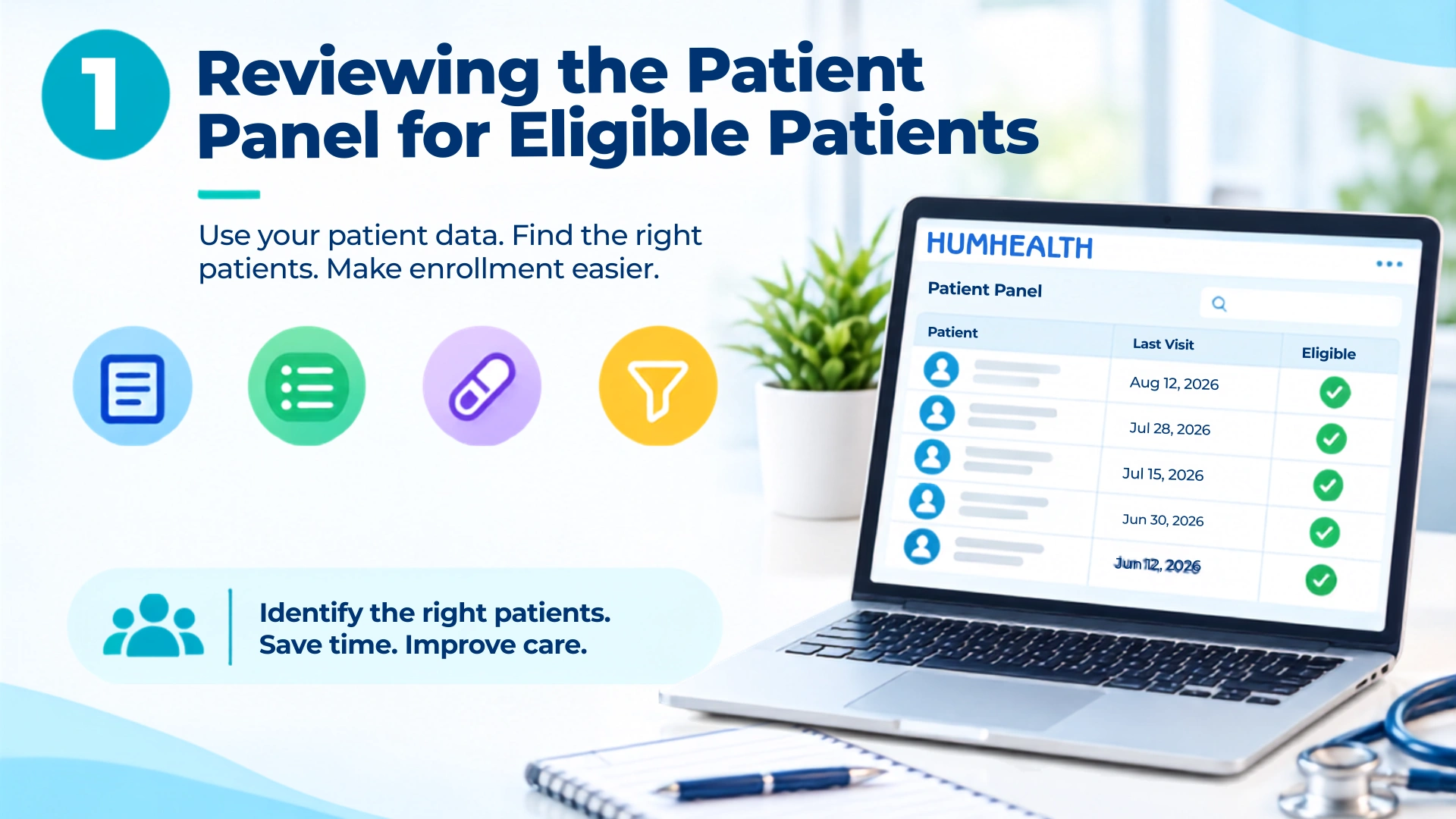
Reviewing the Patient Panel for Eligible Patients
Most practices start the eligibility review by looking at recent visit notes, active problem lists, and medication lists rather than relying on memory. Chronic care management software that can filter a patient panel by diagnosis codes speeds this process up considerably compared with manually reviewing charts one at a time.
Chronic care management software handles this task so staff don’t have to track it manually.
Patients whose care is currently split across multiple specialists are often strong CCM candidates, since a single point of coordination tends to benefit them the most between visits.
The right chronic care management software turns this into a repeatable part of the monthly routine.
The Consent and Enrollment Conversation
Once a patient is identified as eligible, CMS requires informed consent before enrollment. That conversation should cover, in plain language, what the CCM program involves, that the patient can stop participating at any time, and any applicable cost-sharing so the patient understands what to expect. Consent can be verbal or written, but the date, method, and outcome of the conversation need to be documented clearly.
This step depends heavily on how well the chronic care management software is configured.
Reassessing Eligibility Over Time
Eligibility isn’t a one-time determination. A patient’s chronic conditions can change, resolve, or become better controlled, and their care plan should be reassessed periodically. Practices should build a habit of reviewing whether an enrolled patient’s conditions still meet the CCM criteria, rather than assuming initial enrollment settles the question permanently. A brief note at each care plan review confirming that the qualifying conditions are still active and still carry meaningful risk is usually enough to keep the eligibility record current.
Chronic care management software is what ties each of these steps together into one workflow.
How Eligibility Interacts With Enrollment in Other Programs
Many patients who qualify for CCM also meet the criteria for other CMS care management programs, such as Remote Patient Monitoring or Behavioral Health Integration. Eligibility for each program is assessed independently, since the qualifying criteria differ, but a patient with several overlapping chronic conditions is often a reasonable candidate for more than one program at once. Reviewing a patient’s full chronic condition picture at enrollment, rather than evaluating CCM in isolation, can surface additional ways the practice could support that patient’s ongoing care.
Many practices adopt chronic care management software specifically to address this exact challenge.
Common Eligibility Mistakes Practices Make
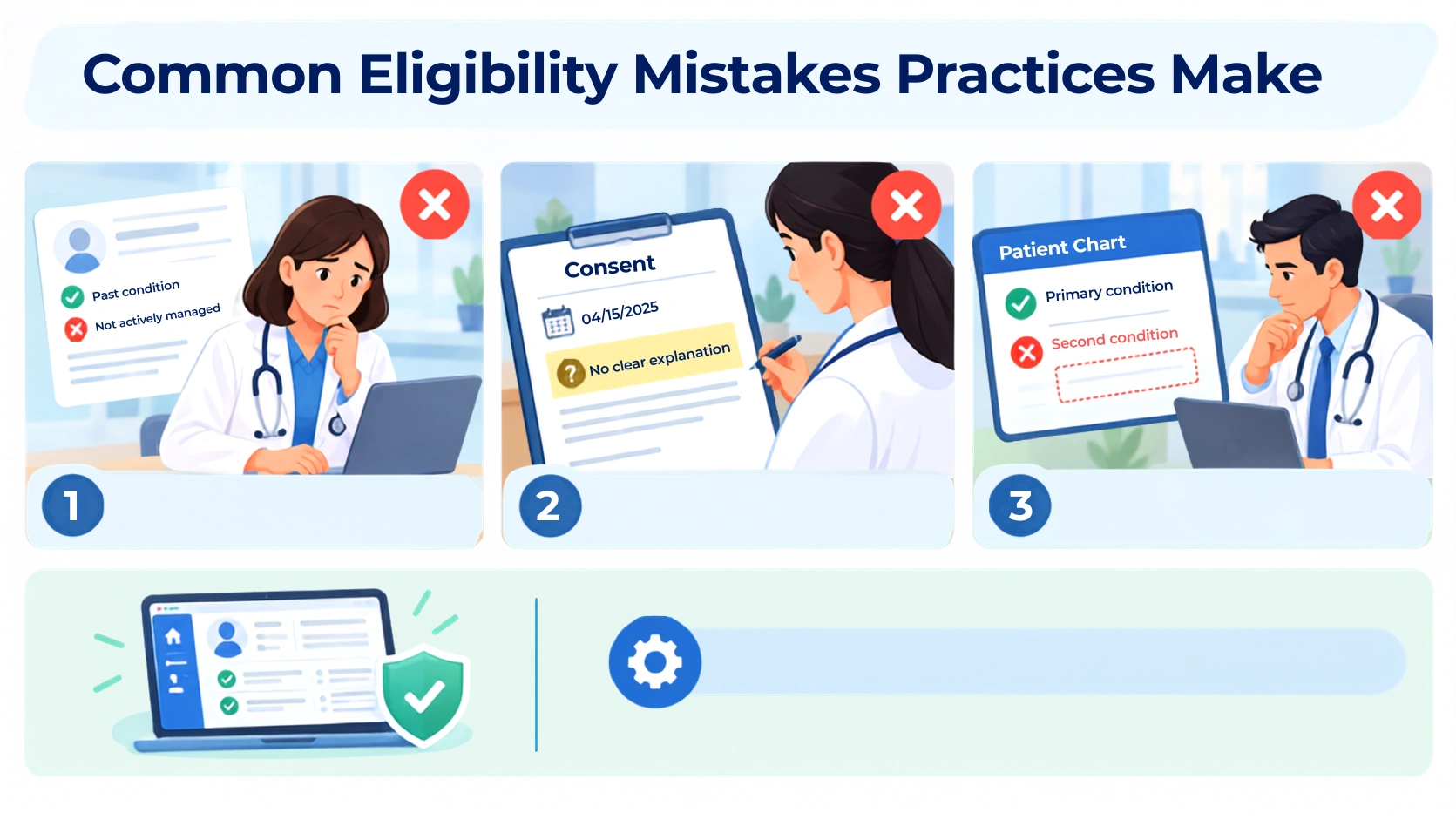
A few patterns show up repeatedly when practices review their CCM enrollment after the fact. Patients are sometimes enrolled based on a diagnosis that appears in their history but isn’t actively being managed, which weakens the eligibility record. Consent conversations are occasionally documented with a date but no clear description of what was actually explained to the patient. And some practices enroll a patient without confirming that a second qualifying condition, beyond the primary reason for the visit, is clearly documented in the chart. Catching these gaps at enrollment is far easier than correcting them months into the program.
Chronic care management software reduces the manual effort involved in this part of the process.
Getting eligibility right at the point of enrollment saves a practice from having to untangle documentation problems later. A clear, consistent process for reviewing the patient panel, confirming qualifying conditions, and documenting consent gives the rest of a chronic care management software program a solid foundation to build on.
This is a core function of any chronic care management software worth evaluating.
Building a Repeatable Eligibility Checklist
Practices that keep their chronic care management software enrollment consistent over time tend to work from a short, repeatable checklist rather than re-deciding the criteria for each new patient from scratch. A useful checklist confirms that at least two qualifying chronic conditions are documented and actively managed, that each condition’s expected duration meets the 12-month standard, that the associated clinical risk is noted, and that the consent conversation has a clear date and description attached to it. Running every new enrollment through the same short list keeps the practice’s documentation consistent regardless of which staff member handles the enrollment conversation.
Practices without chronic care management software often struggle with this specific part of the workflow. Chronic care management software gives the care team a reliable way to manage this step. This reinforces why chronic care management software matters for practices running a CCM program. Chronic care management software is designed to remove exactly this kind of manual burden. A dependable chronic care management software platform keeps this process consistent month over month. Chronic care management software exists precisely to solve problems like the one described here. Evaluating chronic care management software options often comes down to how well they handle this. Chronic care management software should make this step faster, not more complicated.
Other Articles
- What Is Chronic Care Management (CCM)?
- How Chronic Care Management Software Works
- Best Chronic Care Management Software
- CMS Proposed Rule 2026: Key Updates and Implications
Frequently Asked Questions
CMS requires two or more chronic conditions expected to last at least 12 months, or until the patient’s death, with meaningful risk of decline if the conditions go unmanaged between visits.
No. A single chronic condition, regardless of severity, does not meet the CCM eligibility standard on its own. A second qualifying condition must also be present.
Typically yes, an initiating visit with the billing practitioner is generally expected before CCM services begin, though the ongoing monthly CCM activities themselves are non-face-to-face.
Yes. A patient’s chronic conditions can improve, resolve, or change, so practices should periodically reassess whether an enrolled patient still meets the eligibility criteria.
Clear notes identifying each qualifying chronic condition, the expected duration, the associated clinical risk, and a documented consent conversation with date and method all support eligibility during a review.
Either can enroll a patient, provided the enrolling provider is the one primarily responsible for coordinating the patient’s overall chronic condition management.
If you’re evaluating chronic care management software for your practice, you can explore HumHealth’s Chronic Care Management software or book a HumHealth demo.
Related Articles
CCM After TCM: How to Keep Patients Supported Beyond the 30-Day Transition Period
A hospital discharge is the end of an inpatient stay, but it’s not the end of a patient’s care needs. Diabetes, heart…
Chronic Care Management and Annual Wellness Visit: How They Connect in Ongoing Patient Care
Chronic care management (CCM) and annual wellness visit (AWV) programs work best as one connected system, not two separate services. The AWV…

Do Care Management Programs Really Benefit Patients? What the Evidence Shows
Do care management programs really benefit patients? Research and CMS program data suggest they do. Patients in these programs get a personal…