Chronic care management (CCM) and annual wellness visit (AWV) programs work best as one connected system, not two separate services. The AWV gives your care team a yearly, structured look at each Medicare patient’s health, risks, and goals. CCM carries that picture forward every month between visits.
For practices caring for Medicare patients with multiple chronic conditions, this connection matters. Under the CMS Chronic Care Management Services booklet, an AWV can serve as the initiating visit for CCM. That means the same appointment that builds a personalized prevention plan can also open the door to ongoing, remote care coordination.
In this guide, we explain how the AWV and CCM connect, what CMS requires at each step, and how to build a workflow that keeps chronic patients engaged all year.
Key Takeaways
- An AWV can serve as the CCM initiating visit, as long as CCM is discussed during the visit.
- An initiating visit is required only for new patients and patients not seen by the billing practitioner in the past year.
- G0506 can be added once per patient when the practitioner performs an extensive CCM assessment and care planning at the initiating visit.
- CCM consent can be verbal or written, and the AWV is a natural time to document it.
- AWV findings become the foundation of the CCM care plan, and a year of CCM data strengthens the next AWV.
What the AWV and CCM Each Do
The AWV is a once-a-year planning visit, while CCM is a monthly coordination service. One sets the direction; the other keeps patients on course.
The Annual Wellness Visit is a Medicare Part B preventive benefit. It includes a health risk assessment, a review of medical and family history, cognitive and depression screening, a review of functional ability and safety, and a written screening schedule. The result is a personalized prevention plan. Per CMS Medicare Wellness Visits guidance, it is covered once every 12 months, and patients pay nothing when the provider accepts assignment.
Chronic Care Management supports Medicare patients with two or more chronic conditions expected to last at least 12 months, or until death, that place them at significant risk, as defined in CMS care management guidance. Care teams deliver CCM largely between visits through calls, care plan updates, medication management, and coordination with other providers.
| Annual Wellness Visit (AWV) | Chronic Care Management (CCM) | |
|---|---|---|
| Purpose | Yearly prevention planning | Ongoing chronic condition coordination |
| Frequency | Once every 12 months | Every calendar month |
| Format | Face-to-face or telehealth visit | Mostly non-face-to-face |
| Key output | Personalized prevention plan | Comprehensive, living care plan |
| Codes | G0438 (initial), G0439 (subsequent) | 99490, 99439, 99491, 99437, 99487, 99489 |
How the Annual Wellness Visit Initiates Chronic Care Management
According to the CMS Chronic Care Management Services booklet (MLN909188), CMS requires an initiating visit before CCM starts for new patients and for patients the billing practitioner has not seen in the past year. That visit can be a comprehensive evaluation and management (E/M) visit, an AWV, or an Initial Preventive Physical Exam (IPPE).
There is one important condition. The same CMS booklet states that CCM must be discussed during the visit. If the practitioner does not raise CCM during the AWV, the visit cannot count as the initiating visit.
The AWV is a natural fit for this role because so much of its work overlaps with CCM preparation:
- Health risk assessment surfaces chronic conditions, symptoms, and lifestyle risks.
- Medication and history review creates the baseline a CCM care plan needs.
- Cognitive, depression, and functional screening flags patients who may need closer monthly follow-up.
- The list of current providers and suppliers gives care coordinators a head start on coordination.
- The personalized prevention plan sets goals that CCM can track month to month.
Per CMS, the initiating visit is not part of CCM itself. It is billed separately under its own code, so the AWV stays an AWV.
The Connected Care Cycle: AWV to Monthly CCM and Back
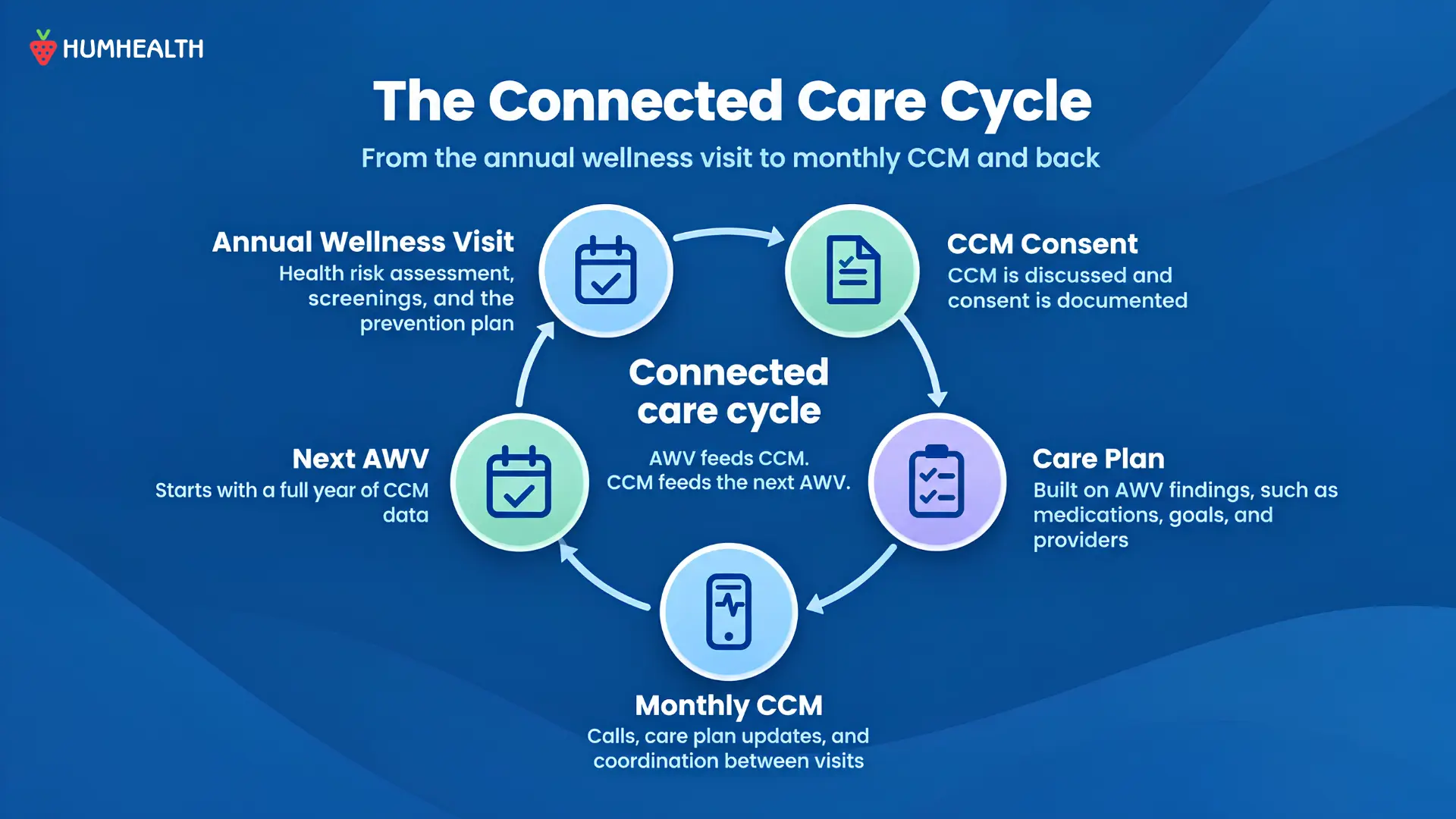
When the two programs are linked, each AWV feeds the next 12 months of CCM, and those months of CCM feed the next AWV. The cycle looks like this:
- 1. Identify eligible patients before the AWV. Review the schedule for Medicare patients with two or more qualifying chronic conditions.
- 2. Complete the AWV. Conduct the health risk assessment, screenings, and prevention planning as usual.
- 3. Discuss CCM and obtain consent. Explain the service, document consent, and confirm the patient understands cost-sharing and their right to stop at any time.
- 4. Build the comprehensive care plan. Use AWV findings, such as problem list, medications, goals, and providers, as the foundation.
- 5. Deliver monthly CCM. Clinical staff follow up by phone or app, track symptoms and medications, and update the care plan.
- 6. Coordinate between visits. Manage referrals, care transitions, and communication with specialists and community services.
- 7. Return to the next AWV with a full year of data. Twelve months of CCM notes make the next health risk assessment faster and more accurate.
This loop turns the AWV from a once-a-year checkpoint into the anchor of year-round, patient-centered care. For help with step 1, see our guide to CCM eligibility requirements and patient enrollment.
Codes, Consent, and Documentation Essentials
Linking the AWV and CCM works smoothly when each service is documented on its own terms. Here are the codes practices use most often along this pathway.
| Code | Service | Notes |
|---|---|---|
| G0438 | Initial AWV | First AWV, after the patient’s first 12 months of Part B |
| G0439 | Subsequent AWV | Each following year |
| G0506 | CCM assessment and care planning add-on | Billed once per patient, with the initiating visit, when the practitioner personally performs extensive assessment and care planning beyond the usual visit work |
| 99490 / 99439 | Non-complex CCM, clinical staff | First 20 minutes per month; each additional 20 minutes |
| 99491 / 99437 | CCM provided personally by the physician or qualified practitioner | First 30 minutes per month; each additional 30 minutes |
| 99487 / 99489 | Complex CCM | First 60 minutes per month; each additional 30 minutes |
CCM code requirements, including G0506, are detailed in the CMS Chronic Care Management Services booklet. AWV codes are described in CMS Medicare Wellness Visits guidance. For current national payment amounts, check the CMS Physician Fee Schedule search tool.
Consent at the AWV
Consent for CCM can be verbal or written, but it must be documented in the medical record. As outlined in the CMS CCM booklet, before starting CCM, inform the patient about the service, applicable cost-sharing, their right to stop at any time, and that only one practitioner can furnish and bill CCM in a given month.
Keep the time separate
The AWV is a face-to-face service. Monthly CCM minutes should reflect only qualifying care management activities performed during that calendar month, not the time spent in the AWV itself.
Optional AWV elements worth knowing
Advance care planning can be furnished with the AWV at the patient’s discretion. For 2026, CMS also revised HCPCS G0136 to describe a standardized assessment of physical activity and nutrition, as outlined in the CMS CY 2026 Physician Fee Schedule final rule summary. Review the CMS care management resources for full CCM requirements.
Looking ahead: CY 2027 proposals (not current requirements)
On July 14, 2026, CMS released the CY 2027 Physician Fee Schedule proposed rule (CMS-1848-P). In it, CMS requests public input on how AWVs and care management services are valued within primary care. This is a request for information, not a finalized policy.
Nothing in the proposed rule changes how the AWV or CCM works today. The requirements described in this article remain in effect unless and until CMS finalizes changes in the CY 2027 final rule. If any related change is finalized, it would take effect no earlier than January 1, 2027.
Our breakdown of the CMS 2027 proposed rule for Medicare care management covers what practices should watch. Practices that already run AWV and CCM as one connected workflow will be well positioned, whatever CMS finalizes.
How HumHealth Connects the AWV and CCM Workflow
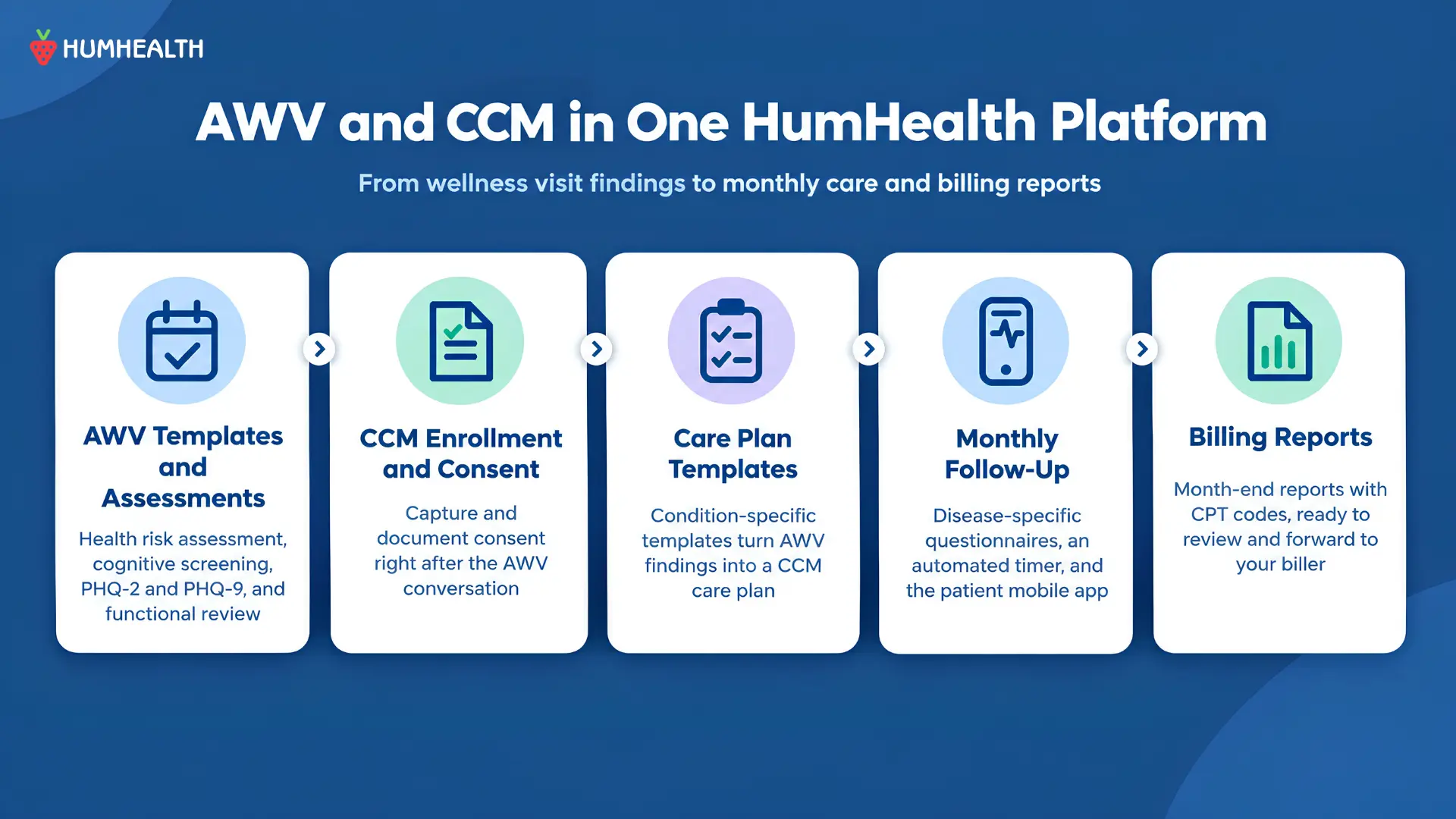
HumHealth supports both the AWV and CCM in one platform, so findings from the wellness visit flow straight into ongoing care. Your team works from one patient record instead of switching between tools.
- AWV templates and assessments. Built-in health risk assessments, cognitive screening, PHQ-2 and PHQ-9 depression screening, functional ability review, and a 5 to 10 year screening checklist.
- Easy CCM enrollment and consent. Capture and document consent right after the AWV conversation.
- Care plan templates. Condition-specific templates help clinicians turn AWV findings into a comprehensive CCM care plan.
- Automated time tracking. A built-in timer records non-face-to-face CCM minutes and tracks physician and clinical staff time separately.
- Monthly follow-up questionnaires. Disease-specific questionnaires keep check-ins consistent.
- Patient mobile app. Patients can view their care plan, record symptoms, and join video calls through the HumHealth mobile app.
- Billing reports with CPT codes. Month-end reports are ready to review and forward to your biller.
What this looks like in practice
Consider a 72-year-old patient with type 2 diabetes and hypertension who comes in for a subsequent AWV. The health risk assessment flags missed medication doses and limited activity. The physician discusses CCM, the patient agrees, and consent is documented in HumHealth before the visit ends.
The AWV findings seed the CCM care plan: medication adherence and blood pressure goals, plus a walking target. Each month, a care coordinator calls, reviews the disease-specific questionnaire, and updates the plan while the timer logs CCM minutes. At the next AWV, the physician opens a full year of notes instead of starting from scratch.
This is an illustrative example, not a specific patient.
HumHealth is 4.8-star rated by real, verified users on Capterra. Practices that also serve patients with fewer chronic conditions can explore Advanced Primary Care Management (APCM) on the same platform.
Conclusion
The AWV and CCM are strongest together. The AWV identifies needs and sets goals once a year, and CCM turns those goals into steady, month-by-month support. When the AWV doubles as the CCM initiating visit, patients move from prevention planning to ongoing care without a gap.
Ready to connect your AWV and CCM programs in one place? Book a demo to see how HumHealth simplifies the full workflow, from wellness visit to monthly care management.
Related Articles
Frequently Asked Questions
The AWV identifies chronic conditions, risks, and goals once a year, and CCM manages those conditions every month in between. The AWV can also serve as the visit that formally starts CCM, so the two create one continuous cycle of care.
Yes. CMS lists the AWV as a qualifying initiating visit for CCM, along with comprehensive E/M visits and the IPPE. CCM must be discussed during the AWV for it to count.
An initiating visit is required for new patients and for patients the billing practitioner has not seen within the past year. Established patients seen in the last 12 months can be enrolled without a new initiating visit.
G0506 is an add-on to the CCM initiating visit, which can be an AWV. It may be billed once per patient when the practitioner personally performs extensive assessment and CCM care planning beyond the usual work of the visit.
No. The initiating visit is billed separately and is not part of CCM. Monthly CCM minutes should include only qualifying care management activities for that calendar month.
Consent must be obtained and documented before CCM begins. It can be verbal or written, and the AWV is a convenient time to collect it.
Medicare covers the AWV with no cost-sharing when the provider accepts assignment. CCM is subject to standard Part B cost-sharing, which should be explained during the consent conversation.
Once every 12 months. The first AWV is available after the patient’s first 12 months of Part B coverage, and not within 12 months of an IPPE.
Yes. HumHealth supports AWV assessments and CCM care plans, time tracking, and billing reports in one platform, so AWV findings carry directly into ongoing CCM.
Related Articles
Annual Wellness Visit CPT Codes and Billing Guide 2025
What is a Medicare Annual Wellness Visit (AWV)? A Medicare Annual Wellness Visit (AWV) is a yearly appointment covered by Medicare Part…

Optimizing Care Team Communications via Message Centers
Remote care monitoring has been widely adopted by health systems, hospitals and clinics worldwide due to the myriad of advantages they provide…

CCM After TCM: How to Keep Patients Supported Beyond the 30-Day Transition Period
A hospital discharge is the end of an inpatient stay, but it’s not the end of a patient’s care needs. Diabetes, heart…