Do care management programs really benefit patients? Research and CMS program data suggest they do. Patients in these programs get a personal care plan, a care team they can reach between visits, help with their medications, and closer follow-up after a hospital stay.
This article looks at care management from the patient’s side. For each benefit, it explains what the service is, what the evidence shows, and what it means for the patient day to day. It also covers how many patients are now enrolled.
What Care Management Programs Are
Care management programs are Medicare services that pay practices for the work done between office visits to keep patients with ongoing health needs on track. Each program is designed for a different patient situation.
| Program | Who it is for | What the patient receives |
|---|---|---|
| Chronic Care Management (CCM) | Patients with two or more chronic conditions | A comprehensive care plan, monthly check-ins, medication management, and 24/7 access to the care team |
| Principal Care Management (PCM) | Patients with one serious, high-risk chronic condition | Focused management of that condition, often by a specialist |
| Transitional Care Management (TCM) | Patients just discharged from a hospital or facility | Contact within 2 business days, a follow-up visit within 7 or 14 days, and medication review |
| Remote Patient Monitoring (RPM) | Patients whose condition benefits from regular readings at home | Connected health devices, regular review of vital readings, and follow-up from the care team when readings need attention |
| Behavioral Health Integration (BHI) | Patients with behavioral health needs | Behavioral health care coordinated within their primary care practice |
| Advanced Primary Care Management (APCM) | Patients whose primary care practice offers advanced primary care | Ongoing, team-based primary care with care management included |
CMS describes CCM as including a comprehensive care plan, 24/7 access to care and health information, continuity of care, and management of care transitions (CMS Chronic Care Management Services, MLN909188). TCM requires contact with the patient within 2 business days of discharge, medication reconciliation, and a face-to-face visit within 7 or 14 days (CMS Transitional Care Management Services, MLN908628). Patients consent to these services and can stop them at any time.
What Care Management Looks Like for a Patient
Without care management, most contact with the care team happens at scheduled appointments, and questions that come up in between often wait. With care management, someone on the care team knows the patient’s conditions, follows their care plan, checks in regularly, and helps between appointments.
| Without care management | With care management |
|---|---|
| Contact with the practice mostly happens at appointments | A care team member checks in by phone or message, usually monthly |
| Questions between visits wait or go to a general phone line | The patient has a named contact and 24/7 access for urgent needs |
| Instructions from each visit are easy to forget | A written care plan is kept current and shared with the patient |
| Medications from different doctors are tracked by the patient | The care team reviews medications and checks for problems |
| Specialists and the primary care practice may not share updates | The care team coordinates updates across doctors |
| After a hospital stay, the patient arranges their own follow-up | The practice calls within 2 business days and schedules a visit |
| Home readings, if any, stay in a notebook | With remote monitoring, readings reach the care team automatically |
The sections below dive into these differences and what the evidence shows.
What Are the Benefits of Care Management for Patients?
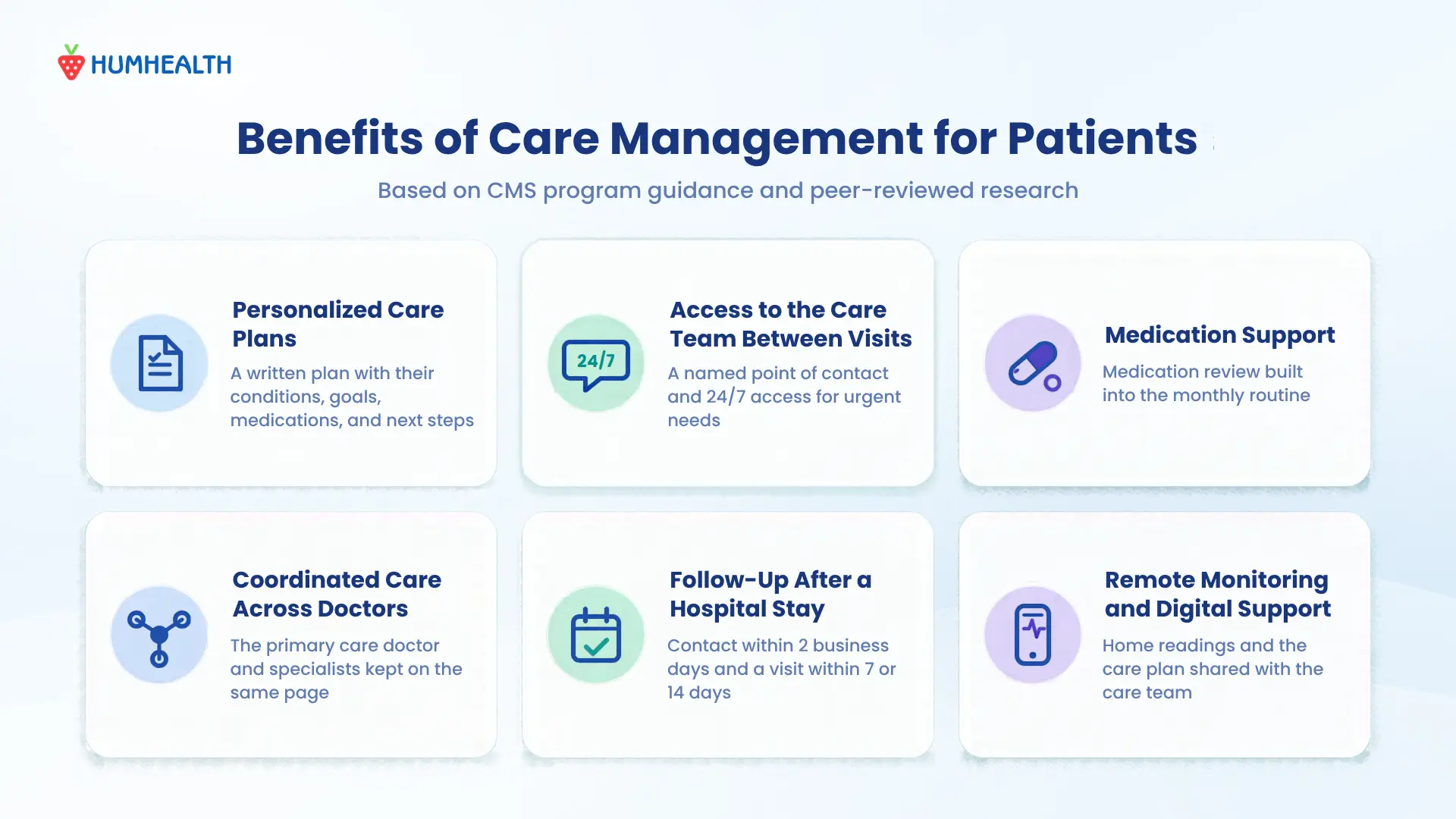
Much of what we know about how patients experience care management comes from a CMS-commissioned evaluation of CCM. In this evaluation, patients and care teams were interviewed, and outcomes were compared between CCM patients and a matched group of similar Medicare beneficiaries (Evaluation of the Chronic Care Management Services, Mathematica for CMS, 2017). The benefits below draw on that evaluation, CMS program guidance, and peer-reviewed research.
Personalized Care Plans
Every CCM patient receives a comprehensive care plan that lists their conditions, medications, goals, and next steps. CMS’s patient fact sheet describes the plan as built with a dedicated health care professional around the patient’s own goals (CMS CCM patient fact sheet). In the CMS evaluation, patients who used their care plan valued having all of their health information in one place.
For the patient, this means a written plan that explains their conditions, goals, medications, and next steps, so they are not responsible for remembering everything from each appointment.
Access to the Care Team Between Visits
Care management gives patients a named point of contact and 24/7 access to a qualified health professional for urgent needs. Patients in the CMS evaluation described feeling they had a direct line to their doctor’s office instead of waiting on hold. Several valued speaking with the same care manager each month, someone who already knew their history, medications, and specialists. As one patient put it, “You’re talking to the same person every time.” Many described the monthly check-ins as reassuring.
For the patient, this means a question about a new symptom or medication does not have to wait for the next appointment.
Medication Support
People with several chronic conditions often take many medications from different prescribers. Care management builds medication review into the monthly routine. In the CMS evaluation, almost all patients said someone from their practice talked with them about their medications to make sure they understood them. One patient described calling her care nurse about a possible interaction between an over-the-counter supplement and her thyroid medication, and she received new instructions from her doctor within minutes. Others said the regular contact helped them keep taking their medications as prescribed.
For the patient, this means someone checks their medications’ compatibility and helps them stay on track.
Coordinated Care Across Doctors and Services
Patients who see several doctors often carry the burden of keeping everyone informed. Care management shifts that work to the care team. Patients in the CMS evaluation said care management helped keep their primary care doctor and specialists on the same page, so test results and updates reached the right people. Care managers also connected frail patients and those with limited support at home to community services.
For the patient, this means fewer repeated explanations and less chasing of results between offices.
Follow-Up After a Hospital Stay
The days after discharge are a high-risk time. TCM makes sure someone from the practice contacts the patient within 2 business days, reviews medications, and sees the patient soon after. A study of more than 18 million eligible Medicare discharges found that patients who received TCM services had lower mortality and lower total health care costs in the following month than similar patients who did not, although as an observational study it shows an association rather than proof of cause (Bindman and Cox, JAMA Internal Medicine).
For the patient, this means they are not left to arrange their own follow-up while still recovering.
Remote Monitoring and Digital Support
Some patients benefit from sharing health readings with their care team between visits. With remote patient monitoring, connected devices such as blood pressure cuffs, glucose meters, and scales automatically send readings to the care team, and the team follows up when a reading needs attention (CMS MLN901705).
Digital tools also help patients stay in touch. CMS notes that care management can include access to a secure electronic patient portal. A patient mobile app takes this further. With an app such as the HumHealth patient mobile app, patients can view their updated care plan, record symptoms, vitals, activity, and diet, and review summaries of their calls with the care team.
For the patient, this means the care plan is in their pocket, and the care team can see how they are doing between conversations.
Research on Hospital and Emergency Visits
In the CMS evaluation, patients receiving CCM had fewer hospitalizations, emergency department visits, and skilled nursing facility stays than the matched comparison group, along with a lower likelihood of hospital admission for conditions such as diabetes, heart failure, urinary tract infection, and pneumonia. The evaluators noted that patients who agree to care management may be more engaged to begin with, which can limit how far the results generalize. CCM patients were also more likely to have advance care planning documented, at 10% compared with 1% across the general Medicare fee-for-service population.
For the patient, these findings suggest that care management may mean more time at home and more say in their own future care.
Care Management Enrollment Is Growing

More patients receive care management each year, and the growth is strongest among patients who need it most.
In the first two years after Medicare began paying for CCM, more than 684,000 beneficiaries received the service, with total enrollment rising steadily each quarter (Mathematica for CMS). A study of Medicare claims then tracked the share of eligible patients, those with two or more chronic conditions, who received CCM each year (Jang et al., Innovation in Aging).
Use grew fastest among patients with the greatest needs. Among beneficiaries with 10 or more chronic conditions, CCM use rose from 2.0% to 7.0%, and among severely frail beneficiaries it rose from 3.3% to 9.4% over the same period.
Transitional care management shows the same direction. TCM was billed after 3.1% of eligible discharges in 2013, 5.5% in 2014, and 7.0% in 2015 (Bindman and Cox), and a later study of 2015 to 2019 claims found TCM delivered after 10.9% of eligible discharges (Innovation in Aging, 2023).
The trend is clearly upward, yet most eligible patients are still not enrolled. That gap is the opportunity: every patient with ongoing conditions who is not yet in a care management program is a patient who could have a care plan, a care team to call, and closer follow-up.
What the Evidence Shows: Yes, Care Management Helps Patients
The research points in a consistent direction. Patients in care management programs get a plan built around their goals, a care team they can reach between visits, regular medication help, coordination across their doctors, and closer follow-up after a hospital stay. Studies have found that patients receiving these services may have fewer hospital and emergency visits and are more likely to have their future care wishes documented. Enrollment is rising each year, fastest among patients with the most complex needs.
For patients, the value of care management is not simply having another healthcare program. It is having someone who knows their health history, helps them follow their care plan, and stays connected between appointments. When those services are delivered consistently and in a way patients can easily use, care management can make ongoing healthcare feel more connected and easier to manage.
Related Articles
Frequently Asked Questions
Care management programs give patients a personal care plan, a care team they can reach between visits, regular medication review, coordination across their doctors, and follow-up after a hospital stay. A CMS-commissioned evaluation found that patients receiving chronic care management had fewer hospitalizations and emergency department visits than similar patients who did not.
Medicare patients with two or more chronic conditions that are expected to last at least 12 months and that place them at significant risk can receive chronic care management. Examples include arthritis, cancer, depression, diabetes, and high blood pressure (CMS CCM patient fact sheet).
Yes. Chronic care management includes 24/7 access to a qualified health care professional for urgent needs (CMS MLN909188). Many practices also use a patient portal or mobile app so patients can stay in touch with their care team between calls.
Someone from the practice contacts the patient within 2 business days of discharge, reviews and reconciles medications, and sees the patient in a follow-up visit within 7 or 14 days (CMS MLN908628). Patients who received these services had lower mortality in the following month than similar patients who did not.
Yes. The share of eligible Medicare patients receiving chronic care management roughly tripled from 1.1% in 2015 to 3.4% in 2019, and use of transitional care management after hospital discharge also rose. Growth was strongest among patients with the most chronic conditions and the greatest frailty.
Yes. Patients consent before care management begins and can stop the services at any time by telling their health care provider (CMS CCM patient fact sheet).
Related Articles
CCM After TCM: How to Keep Patients Supported Beyond the 30-Day Transition Period
A hospital discharge is the end of an inpatient stay, but it’s not the end of a patient’s care needs. Diabetes, heart…
Chronic Care Management and Annual Wellness Visit: How They Connect in Ongoing Patient Care
Chronic care management (CCM) and annual wellness visit (AWV) programs work best as one connected system, not two separate services. The AWV…
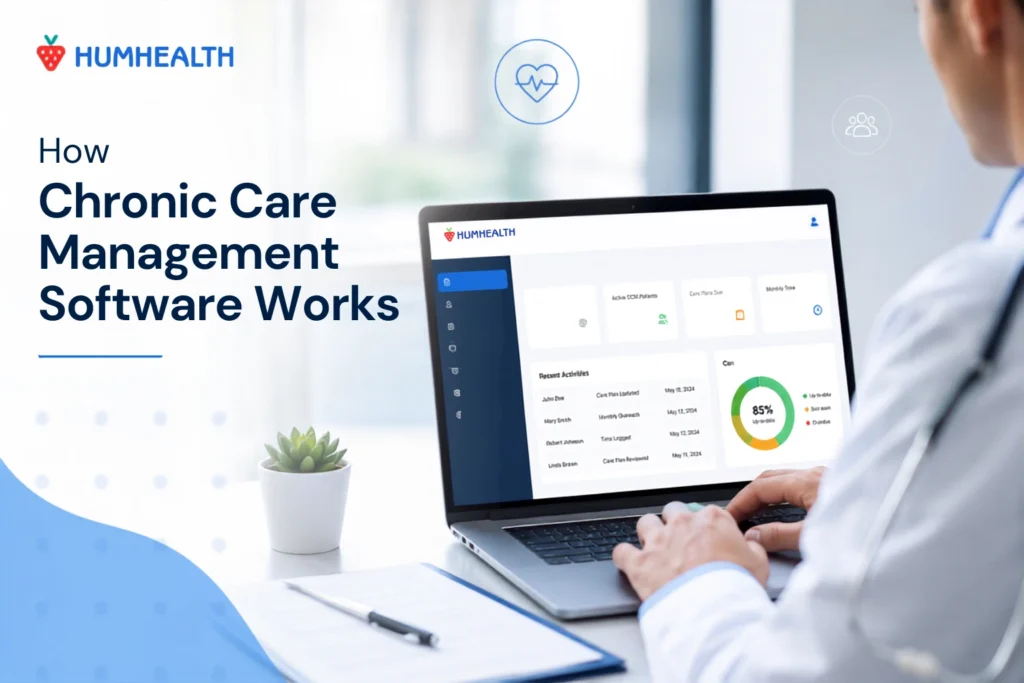
How Chronic Care Management Software Works: A Step-by-Step Guide for Practices
Chronic Care Management (CCM) software is a HIPAA-compliant technology platform that helps healthcare practices deliver, document, and coordinate non-face-to-face care for Medicare…