Introduction
A hospital discharge is the end of an inpatient stay, but it’s not the end of a patient’s care needs. Diabetes, heart failure, hypertension, or COPD patients often leave with new medications, a string of follow-up appointments, and now a care plan to follow. These patients are common: a 2025 CDC analysis found that 78.8% of US adults aged 65 and older reported two or more chronic conditions in 2023.
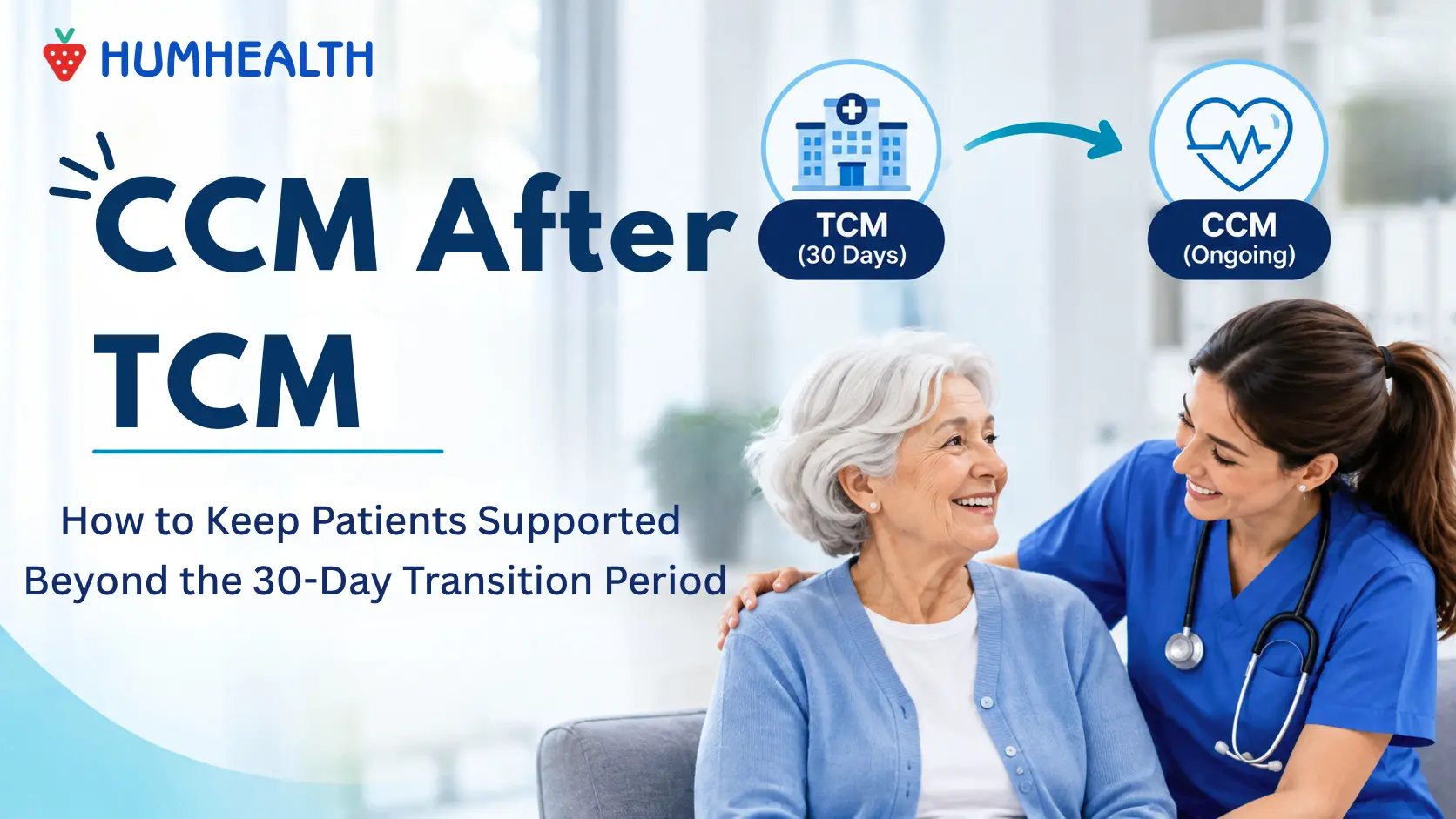
Medicare has two services that treat this time period differently. Transitional Care Management (TCM) covers the 30 days following a qualifying discharge. Chronic Care Management (CCM) is ongoing monthly care management for qualifying patients with two or more chronic conditions.
In this guide, you’ll learn how Chronic Care Management after Transitional Care Management keeps patients connected to their care team, what CMS requires before CCM begins, and how practices can create a workflow that correctly connects the two services.
Patient Needs After the TCM Service Period
According to the CMS Transitional Care Management Services booklet (MLN908628), the TCM service period starts on the discharge date and continues for the next 29 days. During that time frame, the practice:
- Contacts the patient within 2 business days
- Conducts medication reconciliation
- Provides a face-to-face visit within 7 or 14 days, depending on the level of medical decision making
Many patients still require structured support after those 30 days are over. Consider a patient discharged after a heart failure exacerbation who also has type 2 diabetes and hypertension. She may face multiple medication changes, specialist referrals and lab follow-ups that extend well beyond the first month.
Without a continuing care relationship, these tasks can fall to the patient and caregiver alone. Chronic Care Management offers a way to maintain that support month after month for patients who meet CMS eligibility criteria.
What Are Chronic Care Management Services?

CMS describes chronic care management as managing two or more chronic conditions that:
- Are expected to last at least 12 months or until the patient’s death
- Place the patient at significant risk of death, acute exacerbation or decompensation, or functional decline
This definition comes from the CMS CCM services booklet (MLN909188).
CCM services are generally provided outside the face-to-face visit. Core services include recording patient health information, creating an electronic care plan, reviewing medications, managing care transitions, and sharing information between providers, among others, as described in the CMS CCM services booklet. Clinical staff may provide CCM services under the general supervision of the billing provider.
Cost sharing applies to CCM. Before billing, the practice must obtain the patient’s verbal or written consent. The practice must also inform the patient that only one practitioner can bill CCM each month, and that the patient can stop services at any time, effective at the end of the calendar month. Practices that want further explanation on how to meet these conditions may refer to the CCM Eligibility Guide.
Chronic Care Management After Transitional Care Management
Ongoing Care Coordination
Once discharged, the patient will visit their primary care physician, one or several specialists, and other external providers like home health or outpatient therapy services. CCM gives one care team member the task of managing referrals, testing, and appointments across all those sources of care. Following up after a hospital or facility discharge is one of the tasks explicitly mentioned in the CMS booklet.
Medication Management
Medication reconciliation is a required component of TCM, done on or before the face-to-face encounter. CCM builds on this by reviewing medications, identifying interactions, and overseeing how patients manage their medications. If the patient reports side effects or is confused about their regimen, the care team can bring the issue to the prescriber.
Chronic Conditions Management
The acute condition that led to hospitalization may be just one piece of the puzzle of a patient’s overall health. Monthly contact from the care team allows it to:
- Check on the patient’s symptoms
- Reinforce self-management advice
- Track progress toward the goals in the care plan
For a patient with COPD and heart failure, this includes inhaler technique, daily weight trends, and clinical warning signs.
Patient Engagement and Self-Management
CMS expects CCM patients to have a continuous relationship with a chosen care team member and a way to reach the care team between visits, including access to care 24 hours a day, 7 days a week. Regular contact gives patients a consistent place to raise questions. It also helps the care team identify barriers such as transportation, cost, or caregiver availability before they become larger problems.
Care Continuity in Transition
Patient information can become fragmented during transitions between hospitals, SNFs, and clinics. The CCM model requires an up-to-date care plan that is accessible both inside and outside the practice, so every clinician involved in a transition works from the same current information.
TCM and CCM Compared
TCM and CCM both coordinate care, but they have different purposes, timeframes, and billing requirements.
| Feature | TCM | CCM |
|---|---|---|
| Primary purpose | Post-discharge transition | Ongoing chronic condition management |
| Service period | 30-day period starting on the discharge date | Monthly service period |
| Key requirements | Contact within 2 business days, medication reconciliation, face-to-face visit within 7 or 14 days | Eligibility, consent, care plan, applicable monthly time requirements |
| Billing frequency | Once per qualifying 30-day period | Monthly, when requirements are met |
Sources: CMS MLN908628 and CMS MLN909188.
A patient receiving TCM does not automatically qualify for CCM. Each service has its own eligibility criteria, documentation requirements, and billing rules.
CCM Billing During and After the TCM Period

CCM billing does not have to wait until the TCM period ends. According to the CMS CCM booklet, CCM codes 99487, 99489, 99490, and 99491 may be billed for services provided during the 30-day TCM service period.
These codes, together with the CCM add-on code 99439, also appear on the list of codes that can be billed concurrently with TCM in the CMS TCM booklet. If a code is not included in the booklets, the practice should review current CPT and payer instructions.
Concurrent billing applies only when each service is medically reasonable and necessary. Time and effort are never counted twice.
Other CCM billing rules also apply:
- Only one practitioner can bill CCM for a patient in a calendar month.
- Non-complex and complex CCM codes cannot be billed for the same patient in the same month.
- Rural Health Clinics and Federally Qualified Health Centers can also bill CCM and TCM for the same patient in the same time frame.
Since the rules for billing both services depend on specific codes, the practice may want to verify current CPT and Medicare guidelines, as well as any rules from CMS models and demonstrations it participates in.
Workflow for Chronic Care Management After Transitional Care Management
Practices can plan for long-term needs while TCM is still underway, keeping the two services distinct.
- Identify continuing needs during TCM. Use the post-discharge contact and face-to-face visit to identify chronic conditions, medications, referrals, and other needs that will continue beyond 30 days.
- Check eligibility for CCM. Verify that the patient has at least two chronic conditions that meet CMS criteria, without assuming that every patient receiving TCM is eligible for CCM.
- Conduct the initiating visit if needed. CMS requires an initiating visit for a new patient or one who has not been seen in the past year. It should be a comprehensive E/M visit, an Annual Wellness Visit, or an Initial Preventive Physical Exam that includes a discussion of CCM services.
- Get consent from the patient. Inform the patient about the service, cost sharing, the one-practitioner-per-month requirement, and their right to stop services, then document the patient’s informed consent.
- Create the care plan. Document all problems, measurable goals, medications, interventions, and the care team, and make the plan available to other treating clinicians.
- Track time and document every month. Record CCM time separately from TCM tasks, and confirm all requirements are met before billing.
The CMS CCM booklet is the reference for the initiating visit, consent, and care plan requirements in steps 3 through 5.
How HumHealth Can Help With TCM and CCM
Providing both Transitional Care Management and Chronic Care Management takes good documentation and accurate time recording. HumHealth supports both Transitional Care Management and Chronic Care Management on one platform. Care teams can:
- Document patient consent.
- Create and update detailed care plans for both complex and non-complex CCM.
- Record the time spent by the care team with a built-in automated timer.
- Use billing reports to review which services were documented each month.
- Stay connected with patients and each other through communication tools.
Ultimately, the practice remains responsible for determining patient eligibility, exercising clinical judgment and ensuring billing compliance.
Conclusion
Chronic Care Management can continue to support eligible patients after the first 30 days of Transitional Care Management. CCM services can also be reported during the TCM period when all requirements are met. Practices can therefore plan ahead to enroll eligible patients in CCM.
HumHealth can help practices provide both services, from follow-up after discharge to monthly care plans and time recording. Book a demo to find out how HumHealth can help you provide continued care management after discharge.
To summarize, CCM services may be furnished to eligible patients during or following the TCM period, provided the CMS requirements for each service are met and the same time is not counted toward both services.
Sources
- CMS MLN908628, Transitional Care Management Services
- CMS MLN909188, Chronic Care Management Services
- Trends in Multiple Chronic Conditions Among US Adults, By Life Stage, 2013–2023, CDC Preventing Chronic Disease (2025)
Other Articles
Frequently Asked Questions
Yes. CMS allows CCM codes 99487, 99489, 99490, 99491 and add-on code 99439 to be billed during the 30-day TCM period, as long as both services are medically reasonable and necessary and time is not counted twice.
No. CCM has its own eligibility, consent, care plan and time requirements, separate from TCM.
Only if the patient is new or has not been seen by the billing practitioner within the past year. Otherwise, no new initiating visit is required.
The TCM period begins on the discharge date and continues for the next 29 days, for a total of 30 days.
No. Time and effort must not be counted more than once, so CCM time should be documented separately from TCM tasks.
Related Articles
Chronic Care Management and Annual Wellness Visit: How They Connect in Ongoing Patient Care
Chronic care management (CCM) and annual wellness visit (AWV) programs work best as one connected system, not two separate services. The AWV…

Do Care Management Programs Really Benefit Patients? What the Evidence Shows
Do care management programs really benefit patients? Research and CMS program data suggest they do. Patients in these programs get a personal…

How Chronic Care Management Software Works: A Step-by-Step Guide for Practices
Chronic Care Management (CCM) software is a HIPAA-compliant technology platform that helps healthcare practices deliver, document, and coordinate non-face-to-face care for Medicare…