Introduction
Remote monitoring is an increasingly important part of modern healthcare. It allows healthcare providers to keep track of patients using technology. Healthcare professionals can monitor patient data, understand the patient’s progress and make informed decisions about their care.
There are two types of remote monitoring that Medicare recognizes: Remote Patient Monitoring (RPM) and Remote Therapeutic Monitoring (RTM).
While both services involve monitoring patients at a distance, they have different purposes. RPM focuses on monitoring physiologic data, while RTM focuses on monitoring how patients are adhering to and responding to their prescribed therapies.
Understanding the difference between RPM and RTM helps healthcare providers decide which service is the right fit for each patient, and how to bill for it correctly.

What Is Remote Patient Monitoring (RPM)?
Remote Patient Monitoring, also known as Remote Physiologic Monitoring, involves using connected medical devices to collect patient physiologic data and send it automatically to healthcare providers. According to the CMS Telehealth and Remote Patient Monitoring booklet (MLN901705), the device must meet the FDA definition of a medical device, and the data must be transmitted automatically rather than self-reported by the patient.
This data helps healthcare professionals understand how a patient’s health is changing. They can spot concerning trends and make informed decisions about patient care.
Examples of data collected through RPM include:
- Blood pressure
- Blood glucose levels
- Heart rate
- Oxygen saturation (SpO2)
- Weight
- Other physiologic data
How Does RPM Work?
- A healthcare provider identifies a patient who would benefit from remote physiologic monitoring.
- The patient receives a suitable connected medical device.
- The patient is instructed on how to use the device.
- Physiologic data is collected and sent automatically to a secure system.
- Care team members review the data and identify significant changes or concerning trends.
- The healthcare provider communicates with the patient and makes appropriate decisions about their care.
What Is Remote Therapeutic Monitoring (RTM)?
RTM focuses on monitoring how well a patient is adhering to their prescribed therapies and how they are responding to them.
This is different from RPM because RTM focuses on non-physiologic data. That can include therapy adherence, symptoms and the patient’s response to treatment. Unlike RPM, RTM can include certain patient-reported data. It covers three areas: musculoskeletal, respiratory, and cognitive behavioral therapy.
Examples of RTM monitoring include:
- Musculoskeletal: adherence to prescribed exercises or physical therapy, pain levels and progress
- Respiratory: adherence to respiratory therapy, symptoms and response to treatment
- Cognitive behavioral therapy: adherence to eligible digital therapies
Across all three areas, RTM helps the care team understand how well the patient is adhering to their prescribed therapies and how well they are responding to them.
How Does RTM Work?
- A healthcare provider identifies a patient who would benefit from remote therapeutic monitoring.
- A suitable RTM device or technology is chosen based on the patient’s treatment plan.
- The patient is instructed on how to use the monitoring technology.
- Data about the patient’s therapy is collected through connected technology or permitted patient-reported data.
- The care team reviews how well the patient is adhering to therapy, what symptoms they are experiencing and how they are responding to treatment.
- The healthcare provider communicates with the patient and makes appropriate changes to their treatment.
RPM vs RTM: Key Differences
Both programs provide remote care to patients, but they have different aims.
| Comparison | RPM | RTM |
|---|---|---|
| Full name | Remote Patient Monitoring | Remote Therapeutic Monitoring |
| Focus | Physiologic data | Therapy adherence and response |
| Data type | Physiologic, transmitted automatically | Non-physiologic, including permitted patient-reported data |
| What is monitored | Blood pressure, glucose, weight, oxygen saturation | Musculoskeletal, respiratory and cognitive behavioral therapy |
| Technology | Connected blood pressure monitors, glucose meters, scales and pulse oximeters | Eligible therapeutic monitoring devices and digital therapies |
| Who can furnish | Physicians and qualified non-physician practitioners | Physicians, qualified non-physician practitioners, and therapists for certain codes under a therapy plan of care |
| Main aim | Monitor physiologic changes | Evaluate adherence and response to prescribed therapies |
| Typical use | Chronic and acute condition management | Therapeutic intervention and treatment management |
A note on therapist billing: Physical therapists, occupational therapists and speech-language pathologists can furnish certain RTM services under a therapy plan of care. Eligibility depends on the specific code, the provider’s qualifications, the applicable therapy modifiers and the supervision requirements. CMS designated the new 2026 codes 98979, 98984 and 98985 as “sometimes therapy” services, according to the CMS 2026 Therapy Code List update (MM14250).
RPM and RTM CPT Codes and Billing Requirements
RPM and RTM have separate CPT codes under Medicare. The codes cover different parts of the service, such as patient education, device supply and treatment management. Since January 1, 2026, Medicare also recognizes shorter monitoring and management options, as outlined in the CMS CY 2026 Physician Fee Schedule final rule summary (MM14315).
RPM CPT Codes
| CPT Code | Service | Requirement | Avg. Payment* |
|---|---|---|---|
| 99453 | Initial device setup and patient education | Once per episode of care | $22 |
| 99445 | Device supply with daily recordings or programmed alerts (new for 2026) | 2 to 15 days of readings in 30 days | $52 |
| 99454 | Device supply with daily recordings or programmed alerts | 16 or more days of readings in 30 days | $52 |
| 99470 | Treatment management with interactive communication (new for 2026) | First 10 minutes in a calendar month | $26 |
| 99457 | Treatment management with interactive communication | First 20 minutes in a calendar month | $52 |
| 99458 | Add-on to CPT Code 99457 | Each additional 20 minutes | $41 |
| 99091 | Collection and interpretation of data by a physician or qualified health care professional | At least 30 minutes in 30 days | $55 |
Disclaimer: The information provided in this article is for educational and informational purposes only and does not constitute legal, medical, or billing advice. CPT codes, Medicare billing requirements, and reimbursement rates are subject to change and may vary based on payer policies and applicable guidelines. Healthcare providers should verify the latest CMS guidelines and consult a qualified medical billing professional before submitting claims.
RTM CPT Codes
| CPT Code | Service | Requirement | Avg. Payment* |
|---|---|---|---|
| 98975 | Initial setup and patient education on device use | Once per episode of care | ~$22 |
| 98977 | Musculoskeletal device supply and data transmission | 16 to 30 days in a 30-day period | ~$51 |
| 98985 | Musculoskeletal device supply and data transmission (new 2026) | 2 to 15 days in a 30-day period | ~$51 |
| 98976 | Respiratory device supply and data transmission | 16 to 30 days in a 30-day period | ~$52 |
| 98984 | Respiratory device supply and data transmission (new 2026) | 2 to 15 days in a 30-day period | ~$52 |
| 98978 | Cognitive behavioral therapy device supply and data transmission | 16 to 30 days in a 30-day period | Varies by MAC |
| 98986 | Cognitive behavioral therapy device supply and data transmission (new 2026) | 2 to 15 days in a 30-day period | Varies by MAC |
| 98979 | Treatment management, first 10 minutes (new 2026) | 10 to 19 minutes per calendar month | ~$26 |
| 98980 | Treatment management, first 20 minutes | 20 minutes per calendar month | ~$54 |
| 98981 | Add-on to CPT Code 98980 | Each additional 20 minutes | ~$41 |
Disclaimer: The information provided in this article is for educational and informational purposes only and does not constitute legal, medical, or billing advice. CPT codes, Medicare billing requirements, and reimbursement rates are subject to change and may vary based on payer policies and applicable guidelines. Healthcare providers should verify the latest CMS guidelines and consult a qualified medical billing professional before submitting claims.
CMS 2027 Final Rule: New RPM and RTM Requirements
On November 4, 2026, CMS released the Calendar Year (CY) 2027 Medicare Physician Fee Schedule Final Rule. It includes changes to remote physiologic monitoring (RPM) and remote therapeutic monitoring (RTM). The rule applies to payments on or after January 1, 2027.
CMS finalized these policies for CY 2027:
1. RTM for established patients only
RTM services can be furnished only to established patients. RPM already has this requirement.
An established patient is one who has received any professional services from the physician or other qualified health care professional, or from another physician or qualified health care professional of the same specialty in the same group practice, within the past three years.
CMS also clarified that a beneficiary may be considered an established patient after meeting the initiating visit requirements for remote monitoring services.
2. Initiating visit for RPM and RTM
- The initiating visit must be performed by the billing practitioner or an eligible physician in the same group practice and same specialty.
- RPM or RTM must be discussed with the patient during the visit.
- The visit may be conducted in person or through eligible telehealth.
Patients already receiving remote monitoring before January 1, 2027, do not need a new initiating visit to continue their services.
3. Employed clinical staff requirement delayed to 2029
CMS had proposed paying for RPM and RTM services only when they are performed by clinical staff employed by the practice, not by contractors. After reviewing public comments, CMS delayed this requirement by two years to give practices more time to adapt. It takes effect for RPM and RTM services beginning January 1, 2029.
4. No Change to Existing RPM and RTM CPT Codes
CMS proposed bundling the RPM and RTM CPT codes into four new HCPCS G-codes, but did not finalize this proposal. CMS said it may consider the public comments it received in future rulemaking.
Source: CMS Fact Sheet: CY 2027 Medicare Physician Fee Schedule Final Rule, November 4, 2026
Can RPM and RTM Work Alongside CCM, TCM and Other Care Management Programs?
Patients may have clinical needs that require ongoing physiologic monitoring, therapeutic monitoring, and additional care management services. Under Medicare Physician Fee Schedule (PFS) guidelines, Remote Patient Monitoring (RPM) and Remote Therapeutic Monitoring (RTM) may be furnished alongside certain other care management services when applicable billing requirements are met. However, RPM and RTM cannot be billed concurrently for the same patient during the same period.
| Combination | Can be billed together? |
|---|---|
| RPM + CCM | Yes, when applicable requirements are met |
| RTM + CCM | Yes, when applicable requirements are met |
| RPM + TCM | Yes, when applicable requirements are met |
| RTM + TCM | Yes, when applicable requirements are met |
| RPM + RTM | No, cannot be billed concurrently |
According to the CMS Chronic Care Management Services booklet, eligible practitioners may bill RPM or RTM alongside CCM or TCM, subject to applicable Medicare billing requirements. The CMS Telehealth and Remote Patient Monitoring booklet also addresses concurrent billing of RPM or RTM with other eligible care management services, including Behavioral Health Integration (BHI), Principal Care Management (PCM), and Chronic Pain Management (CPM).
Each service must independently satisfy its applicable coverage, medical necessity, documentation, and billing requirements. Time spent performing one service cannot be counted toward the time requirements of another separately billed service. Practitioners must also follow applicable CPT code restrictions, Medicare payment policies, and payer-specific requirements.
For example, a patient receiving CCM who requires additional physiologic monitoring may qualify for CCM and RPM when both services are medically necessary and their respective billing requirements are satisfied. Similarly, a patient receiving CCM who requires monitoring of therapy adherence or treatment response may qualify for CCM and RTM, provided all applicable requirements are met.
The appropriate combination depends on the patient’s clinical needs, medical necessity, service eligibility, and applicable Medicare or other payer policies. Concurrent billing eligibility does not automatically establish coverage or guarantee reimbursement.
Patient Eligibility and Documentation Requirements
Patient Eligibility
Before starting RPM or RTM, the practice should confirm that the service is reasonable and necessary for the patient’s diagnosis or treatment. RPM can support patients with chronic or acute conditions that benefit from regular physiologic readings. RTM supports patients whose care depends on following a prescribed musculoskeletal, respiratory or cognitive behavioral therapy.
According to the CMS Telehealth and RPM booklet, a few requirements apply:
- Remote monitoring is furnished to established patients.
- The patient’s consent must be obtained and documented.
- Only one practitioner may bill RPM for a patient in a 30-day period.
Documentation Requirements
Clear records protect the practice and make month-end billing reviews faster. For each patient, practices should document:
- The patient’s consent to remote monitoring
- The treatment plan and the reason monitoring is needed
- The monitoring data received and the number of days collected
- The clinical review of that data and any actions taken
- Communication with the patient or caregiver, including the required interactive communication for treatment management
- Time records for treatment management, kept separate from time billed to other programs
Challenges in Managing Remote Monitoring Programs
Remote monitoring brings clear benefits, but running a program well takes planning. Practices commonly face five challenges.
Patient adherence. Monitoring only works when patients take readings or report data consistently. Clear onboarding, simple devices and regular check-ins help keep patients engaged.
Device connectivity. Bluetooth pairing problems, weak cellular signals or dead batteries can interrupt data flow. Cellular-enabled devices and quick technical support reduce gaps in monitoring days.
Staff workload. Reviewing incoming data, responding to alerts and contacting patients takes time. Defined roles and alert thresholds help care teams focus on the patients who need attention most.
Data review. Large volumes of readings can be hard to act on without a clear view of trends. Dashboards that flag out-of-range values help clinicians respond quickly.
Billing documentation. Tracking monitoring days, management time and interactive communication by hand leads to missed or incorrect claims. Built-in time tracking and reporting make each month’s billing review easier to support.
How HumHealth Supports RPM and RTM
Managing remote monitoring programs requires the right systems. Care teams need to view data, record activities, communicate with patients and make sure follow-up happens.
HumHealth supports both Remote Patient Monitoring and Remote Therapeutic Monitoring on one platform. Care teams can:
- View patient data in one place.
- Record readings from connected Bluetooth and 4G devices.
- Monitor patient adherence and progress.
- Receive alerts and notifications.
- Communicate with the care team and record follow-ups.
- Record treatment management activities and time spent.
- Generate reports that support billing.
With these features in one connected platform, your care team can see how each patient is being monitored and follow up at the right time. Ultimately, the practice remains responsible for determining eligibility and ensuring billing compliance.
Conclusion
RPM and RTM are both remote monitoring services, but they serve different purposes.
RPM helps healthcare providers understand how a patient’s physiologic data is changing, including blood pressure, blood glucose and oxygen saturation. RTM helps healthcare providers understand how well patients are adhering to and responding to their prescribed therapies.
Both help you monitor patients outside traditional clinical settings, so the right choice depends on what you need to monitor. Understanding the differences between RPM and RTM, along with their billing rules, helps you choose the right service and build a care plan that fits each patient’s individual needs.
Request a demo to see how HumHealth can help your practice run RPM and RTM programs.
Related Articles
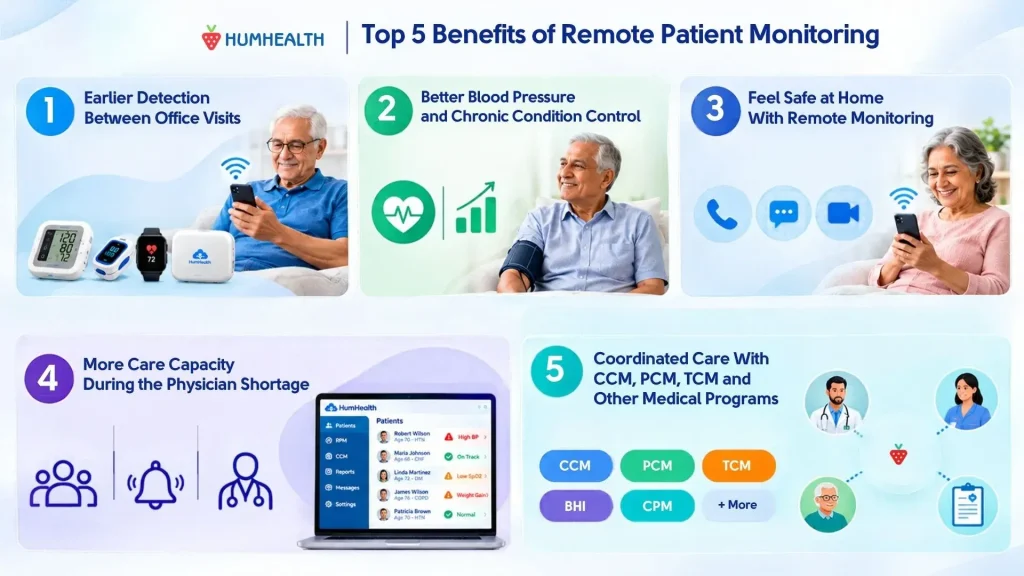
5 Benefits of Remote Patient Monitoring for Patients and Practices
The five main benefits of remote patient monitoring (RPM) are: 1. Earlier detection of health changes between office visits 2. Better blood…
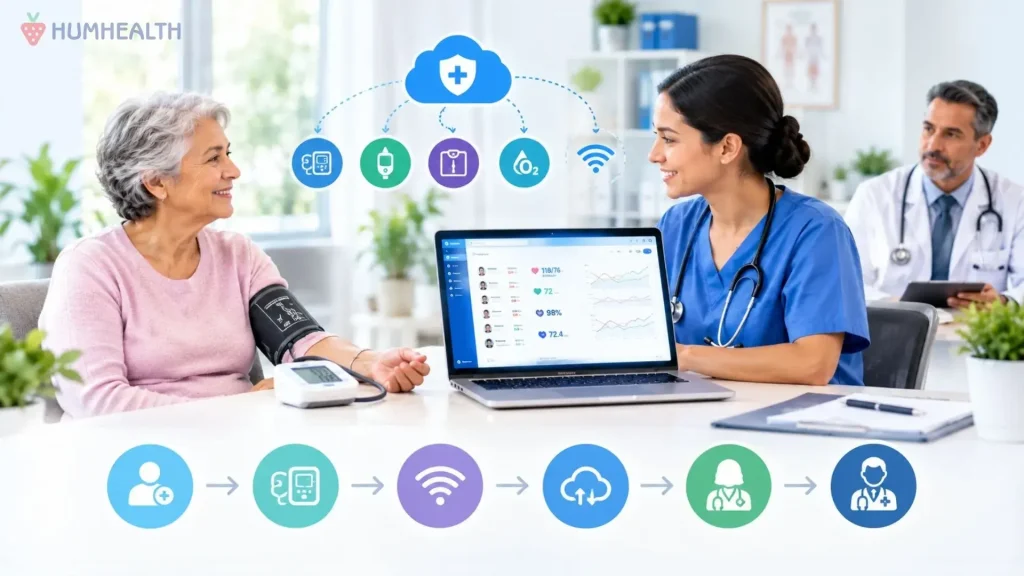
Remote Patient Monitoring for Independent Practices
Independent practices are built on long-standing patient relationships, direct physician involvement, and the ability to make operational decisions quickly. Those same qualities…
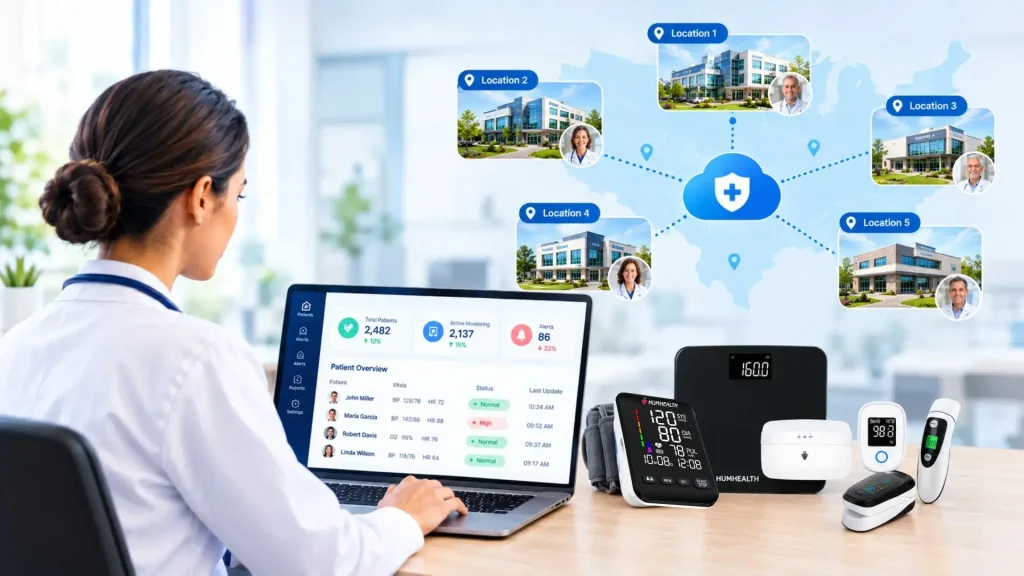
How Large Practices Can Launch Remote Patient Monitoring at Scale
A remote patient monitoring program that works well in a single clinic does not automatically work at a health system with a…