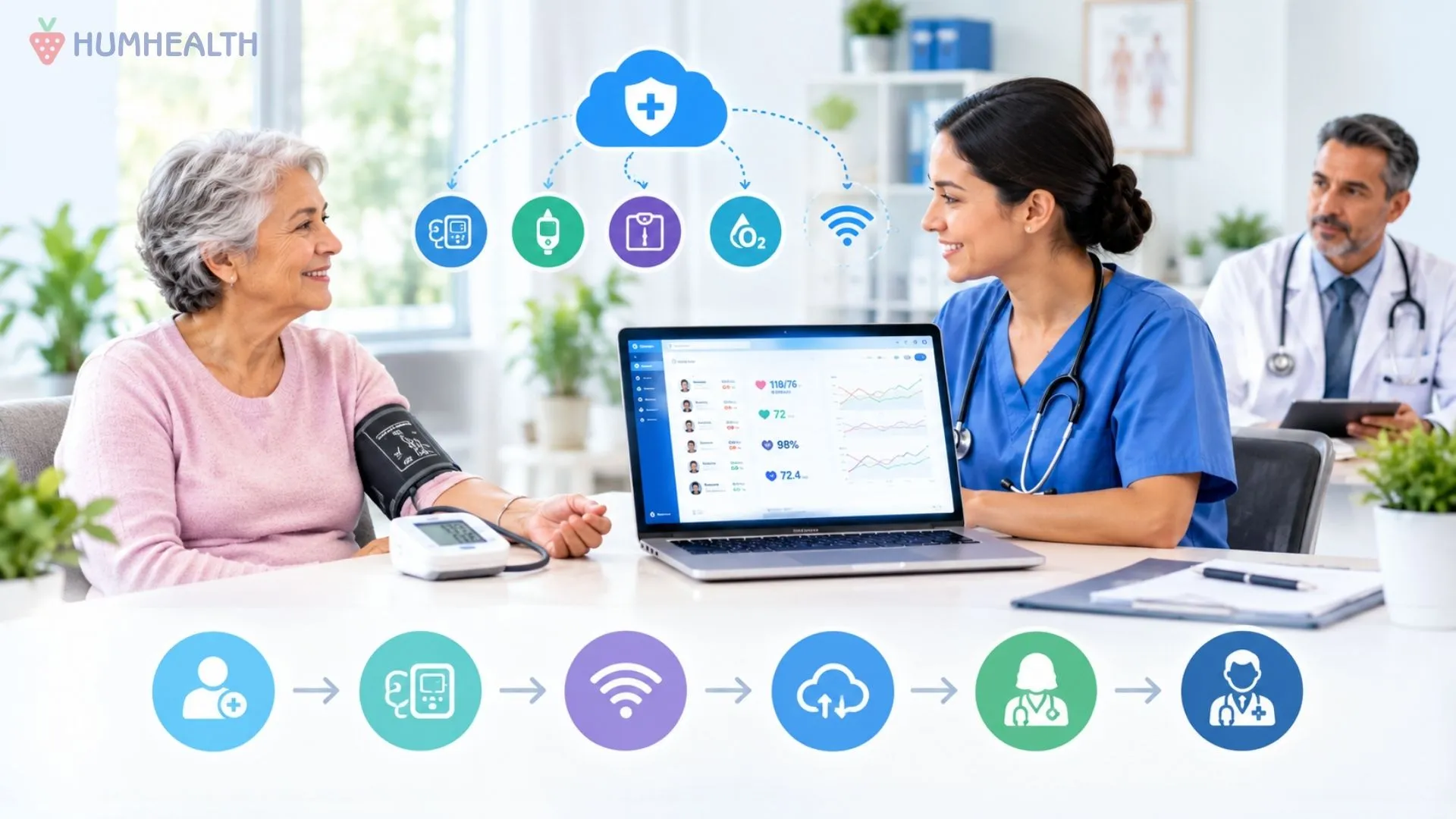
Independent practices are built on long-standing patient relationships, direct physician involvement, and the ability to make operational decisions quickly. Those same qualities make them well suited to running a strong remote monitoring program. Patients already know and trust their care team, physicians are close to day-to-day clinical work, and new workflows can be adopted without layers of institutional approval.
Remote patient monitoring for independent practices extends that model beyond the office visit. Patients use connected devices at home, readings are transmitted automatically to the practice, and the care team reviews the data and follows up when clinically appropriate. When the program is built around the right patients and billed according to Medicare requirements, RPM gives the practice a structured, reimbursable way to manage chronic conditions between appointments.
This guide explains how RPM works in an independent practice, the Medicare codes and requirements that apply in 2026, how to design the workflow and staffing model, what the CY 2027 proposed rule means for program planning, and what to look for in RPM software.
Why Independent Practices Are Well Positioned for RPM
Several characteristics of physician-owned practices align closely with what successful RPM programs require.
Established patient relationships support enrollment and sustained participation. Medicare requires an established patient relationship for RPM, and patients are generally more willing to use a monitoring device and respond to outreach when the request comes from a clinician they already see.
Direct physician oversight keeps monitoring connected to the treatment plan. In an independent practice, the physician reviewing escalated readings is often the same physician managing the patient’s medications, which shortens the path from data to clinical decision.
A consistent care team supports continuity. When the same nurse or medical assistant reviews a patient’s readings each month, they learn that patient’s baseline, communication preferences, and typical patterns, which makes review more efficient and outreach more effective.
Operational agility makes it practical to start with a focused patient group, refine the workflow, and expand deliberately.
How Remote Patient Monitoring Works in a Practice Setting
CMS describes remote physiologic monitoring as the use of non-face-to-face technology to monitor and analyze a patient’s physiologic metrics, which the practitioner then uses to treat or manage the patient’s condition. In practice, the workflow has three parts.
The patient uses a connected device at home, such as a blood pressure cuff, glucometer, weight scale, or pulse oximeter. The device transmits readings automatically, typically over a cellular connection, so the patient does not need to log in to any system or enter values manually. CMS requires that physiologic data be electronically collected and automatically uploaded to a secure location where it is available for analysis and interpretation by the billing practitioner, and that the device meet the FDA definition of a medical device.
The practice’s RPM software receives those readings and organizes them for the care team. Clinical staff review trends, respond to readings that fall outside configured thresholds, and contact the patient when follow-up is appropriate.
The billing practitioner oversees the program, uses the data to manage the treatment plan, and remains responsible for clinical decisions and documentation.
The software is a practice-side tool. Patients interact with their devices, and the care team interacts with the platform.
Medicare RPM CPT Codes in 2026
The CY 2026 Medicare Physician Fee Schedule final rule, effective January 1, 2026, added two RPM codes, 99445 and 99470. They address reporting for months with fewer than 16 days of data transmission or less than 20 minutes of treatment management time, giving practices a billing pathway that better matches each patient’s monitoring needs.
| CPT Code | Service Component |
|---|---|
| 99453 | Initial device setup and patient education on use of the equipment |
| 99454 | Device supply with daily recordings or programmed alert transmissions, 16 to 30 days in a 30-day period |
| 99445 | Device supply with daily recordings or programmed alert transmissions, 2 to 15 days in a 30-day period (new for 2026) |
| 99457 | Treatment management services, first 20 minutes of clinical staff, physician, or other qualified health care professional time in a calendar month, requiring interactive communication with the patient or caregiver during the month |
| 99458 | Treatment management services, each additional 20 minutes in a calendar month |
| 99470 | Treatment management services, first 10 minutes of clinical staff, physician, or other qualified health care professional time in a calendar month, requiring one real-time interactive communication with the patient or caregiver during the month (new for 2026) |
Codes 99445 and 99454 describe the same device supply service at different data thresholds and are not reported together for the same 30-day period. Codes 99470 and 99457 are likewise not reported together in the same calendar month. Descriptors above are summarized; official code descriptors are published in the AMA CPT code set, and payment rates vary by locality and are published in the CMS Physician Fee Schedule. For a closer look at program economics, see our guide to remote patient monitoring revenue per patient.
Core Medicare Requirements for RPM
Under current CMS guidance, remote physiologic monitoring requires an established patient relationship, and CMS requires patient consent at the time RPM services are furnished. Monitoring must be for an acute or chronic condition and must be medically reasonable and necessary. Only physicians and nonphysician practitioners eligible to furnish evaluation and management services can bill RPM. Only one practitioner can bill RPM for a patient in a 30-day period, and RPM and remote therapeutic monitoring (RTM) cannot be billed together. Auxiliary personnel can furnish RPM services under the general supervision of the billing practitioner.
Documentation should reflect the data transmitted, the time spent, the interactive communication with the patient, and how the information was used in managing care.
Building an RPM Program in an Independent Practice
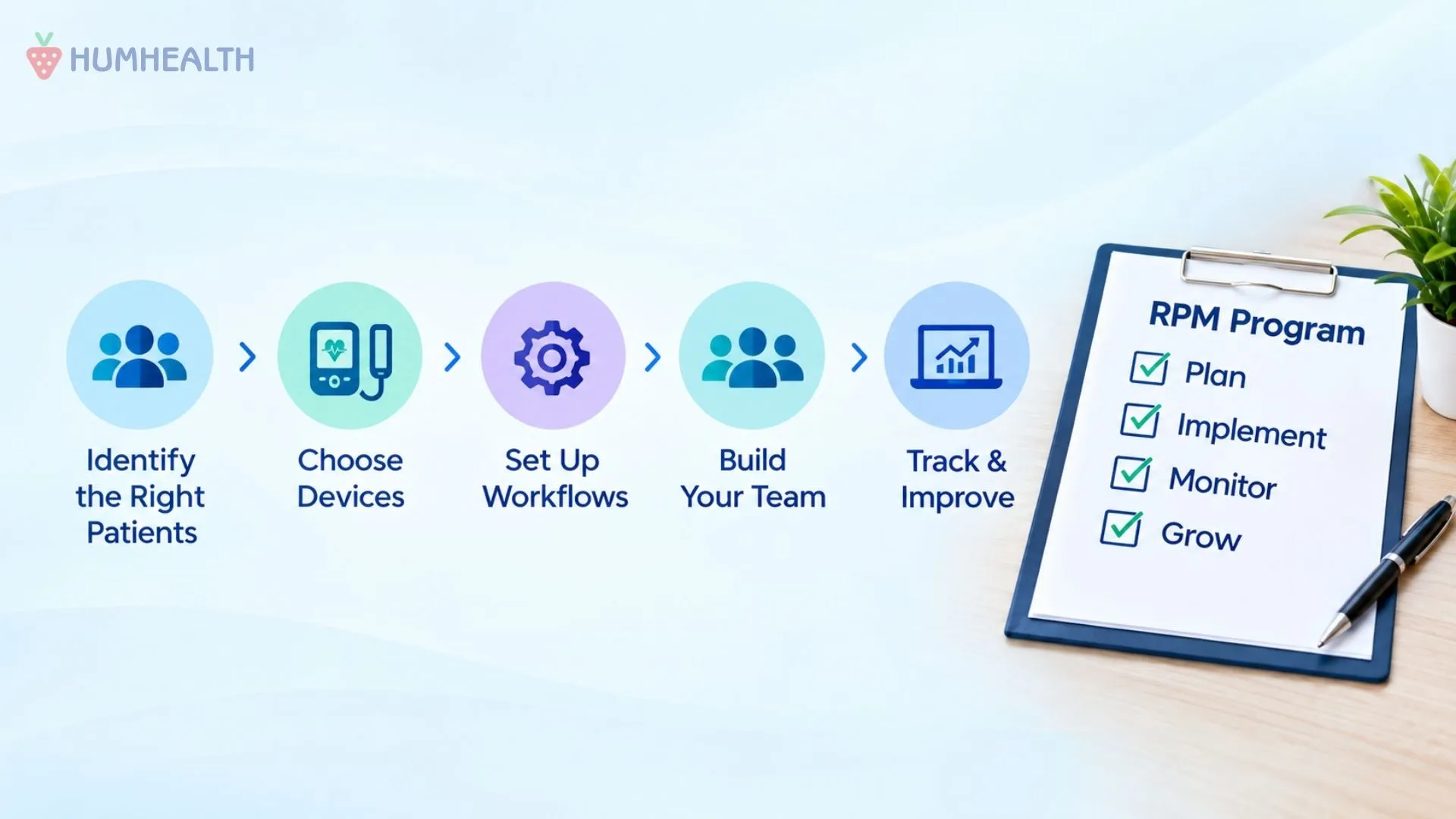
A well-designed program is defined before the first device ships. The following components form the foundation.
Patient Selection
Start with a defined population, such as established patients with hypertension, diabetes, or heart failure whose management would benefit from more frequent data. Confirm clinical appropriateness for each patient individually and document the condition being monitored. A focused initial cohort allows the team to refine the workflow before expanding.
Care Team Roles
Assign clear responsibility for each part of the workflow: who reviews readings and how often, who conducts monthly patient communication, who escalates readings to the physician, and who reviews documentation before billing. In most independent practices, a nurse or medical assistant handles daily review and outreach, and the physician manages escalations and treatment changes.
Device Selection
Choose devices that match the clinical use case and are simple for patients to operate. Cellular-connected devices that transmit automatically, without smartphone pairing, reduce setup effort for patients and support calls for staff.
Patient Onboarding and Consent
Onboarding should explain why the patient is enrolled, how the device works, how readings reach the practice, what to do if a reading seems abnormal, and whom to contact with questions. Consent should be obtained and documented.
Alert Thresholds and Response Protocols
Set patient-appropriate thresholds and define how the team responds when a reading falls outside them, including timeframes for review and criteria for physician escalation. Alerts are information for the care team to evaluate, and a written protocol keeps response consistent across staff.
Documentation and Billing Workflow
Build documentation into the monitoring workflow itself so that transmission days, management time, and interactive communication are captured as the work happens. This supports accurate code selection each month, particularly with the 2026 thresholds for 99445 and 99470.
Program Performance Review
Review program metrics monthly, including enrollment, transmission rates, staff time per patient, patient engagement, and billing accuracy. These measures show where the workflow is running smoothly and where adjustments will improve efficiency.
RPM Staffing Models for Independent Practices
Practices generally use one of two staffing approaches. In an in-house model, the practice’s own nurses or medical assistants review readings and conduct patient communication using RPM software. In an outsourced model, a third-party vendor supplies clinical staff who perform monitoring and outreach on the practice’s behalf.
The in-house model keeps patient communication within the practice’s own care team, which supports continuity and gives the practice direct control over quality and documentation. It also aligns naturally with the independent practice model, in which patients already have relationships with the clinical staff. A practical starting point is to assign RPM review to existing clinical staff with protected time each day, then add capacity as enrollment grows.
Staffing decisions are also relevant to proposed, not yet final, Medicare policy changes described in the next section.
The CY 2027 Proposed Rule and RPM Planning
In July 2026, CMS released the CY 2027 Medicare Physician Fee Schedule proposed rule (CMS-1848-P). Several of its proposals would affect remote monitoring programs if finalized.
CMS proposed that practitioners reporting RPM or RTM would be required to furnish a separately reportable initiating visit associated with the onset of monitoring services. According to analyses of the proposed rule, the visit could take place in person or through telehealth, and remote monitoring would need to be discussed with the patient at that visit.
CMS also proposed that RPM and RTM would be payable only when performed by clinical staff employed by the practice, and not when those services are delivered by contractors. Legal analyses of the proposal note that CMS indicated this proposed direct employment standard would not require staff to be physically present in the office, provided they are direct employees working under the billing practitioner’s general supervision.
The proposed rule would also extend the established patient requirement to RTM and proposes changes to how remote monitoring services are valued.
None of these provisions are current requirements. They are proposals. The public comment period closed on September 14, 2026, and CMS is expected to publish a final rule later in the year. The final rule may adopt, modify, or withdraw any of these provisions.
Because these proposals could be finalized, practices may want to prepare for that possibility. Practices building a new program can consider staffing it with their own employed clinical staff and documenting a visit at which remote monitoring is discussed with the patient during enrollment. Practices currently working with a vendor for clinical monitoring staff may want to review how that arrangement is structured with counsel. For a closer look at what these proposed changes could mean across RPM, RTM, and other care management programs, see our guide to the CMS 2027 proposed rule.
RPM Software Requirements for Independent Practices
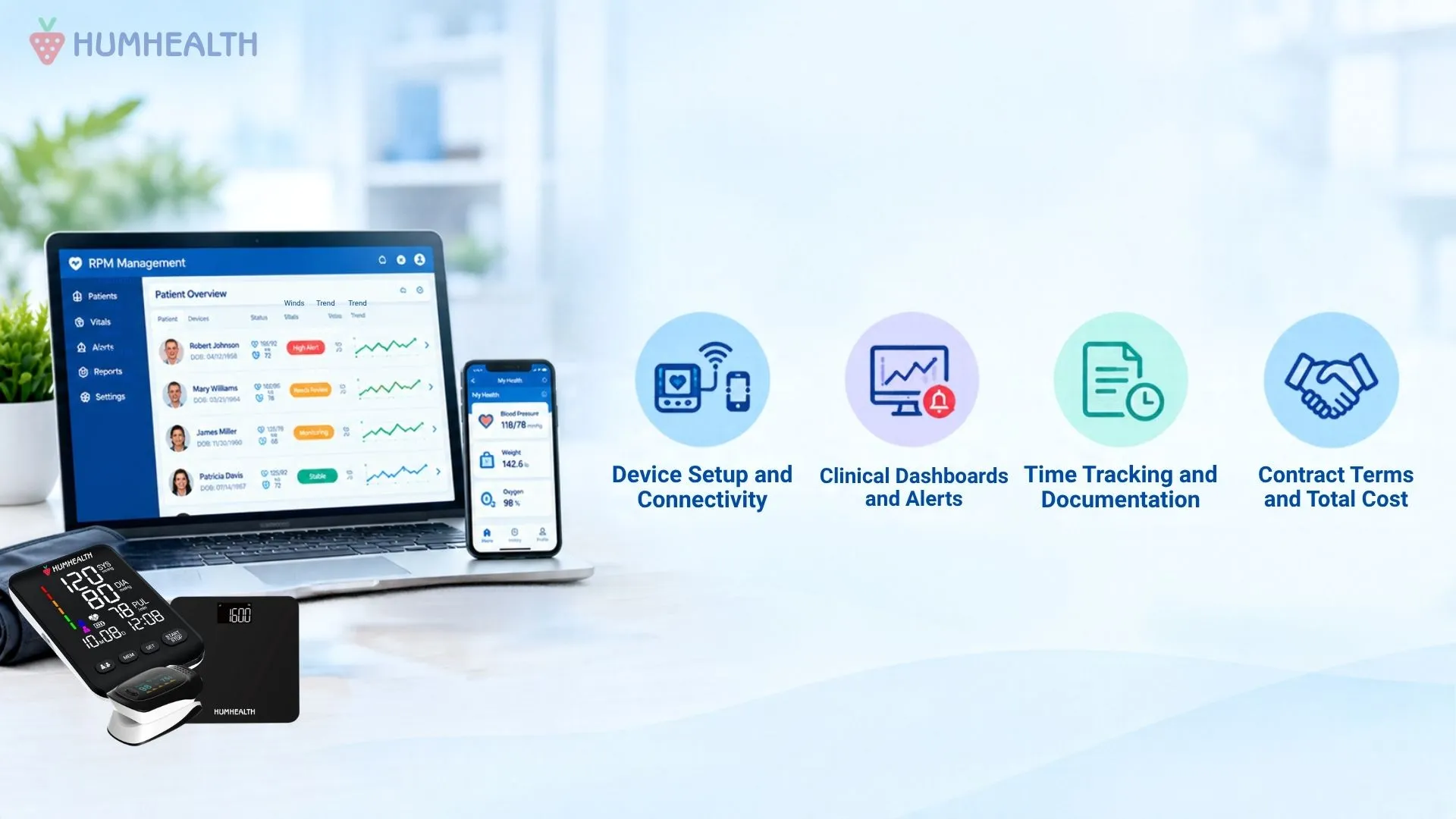
The most useful platform for an independent practice is one that fits the way its care team already works and keeps the RPM workflow in one place.
Device Setup and Connectivity
Practices should confirm how devices are shipped and configured, how transmission issues are identified and resolved, who handles device troubleshooting, and how replacements are provided. Reliable connectivity directly supports consistent data transmission.
Clinical Dashboards and Alerts
Staff should be able to see at a glance which patients are active, which readings require review, how many days of data each patient has transmitted this month, and how much management time has been logged. Configurable threshold-based alerts help the team prioritize review.
Time Tracking and Documentation
With the 2026 codes, the difference between 10 and 20 minutes of management time, or between 2 to 15 days and 16 to 30 days of data, determines which code applies. Software that tracks transmission days and staff time automatically, and records interactive communication, supports accurate code selection and complete documentation.
Contract Terms and Total Cost
Practices should evaluate total cost across implementation, devices, software, support, and replacement policies, along with contract length, minimum patient commitments, and cancellation terms. It is also worth confirming how the vendor’s model accommodates in-house clinical staff, given the pending proposals.
Our guide to remote patient monitoring for small clinics covers additional considerations for practices with smaller teams.
RPM and CCM for the Same Patients
Many patients who qualify for RPM also qualify for Chronic Care Management (CCM). The two services have different purposes. RPM centers on physiologic data from connected devices. CCM centers on care planning and coordination for patients with two or more chronic conditions expected to last at least 12 months.
CMS allows RPM to be billed concurrently with certain care management services for the same patient, including CCM, transitional care management, behavioral health integration, principal care management, and chronic pain management, when the requirements for each service are met and time and effort are not counted twice. A combined workflow works best when staff know which service they are performing during each patient interaction and document it accordingly.
Practices offering both programs can learn more on our Chronic Care Management software page.
RPM Best Practices for Independent Practices
Programs that perform well over time tend to share several practices. They are designed around a defined clinical population and a clear treatment purpose for each enrolled patient. They use a single platform for monitoring, time tracking, and documentation, which avoids re-entering information across systems. They apply written review protocols so that alerts are handled consistently and escalated appropriately. They keep documentation current with the services furnished each month. And they grow enrollment at a pace the care team can support, reviewing performance data before each expansion.
How HumHealth Supports Independent Practices
HumHealth’s remote patient monitoring software brings the core RPM workflow into one platform for the practice’s care team. Staff can manage patient enrollment and device assignment, review physiologic readings from connected devices, configure threshold-based alerts, track transmission days and management time, and generate RPM documentation and billing reports.
Because the platform is designed for use by a practice’s own clinical staff, it supports independent practices that run RPM in-house. For practices that also offer CCM, HumHealth supports both programs within the same platform, which helps teams keep time and documentation separate across services.
The clinical team remains responsible for reviewing patient information, making clinical decisions, and meeting applicable Medicare and payer requirements.
To see how the workflow would fit your practice, book a demo.
Building a Sustainable RPM Program
Remote patient monitoring for independent practices works best when it builds on what these practices already do well: knowing their patients, keeping physicians close to clinical decisions, and adapting workflows quickly. A focused patient population, clear care team roles, reliable devices, written protocols, and software that keeps monitoring and documentation in one place together form a program the team can sustain and grow.
The 2026 codes give practices more flexibility to match billing to each patient’s monitoring needs. With the CY 2027 proposals still pending, practices may also want to prepare for the possibility of in-house staffing and initiating-visit requirements if they are finalized, while continuing to follow current Medicare rules.
Sources
- CMS: Remote Patient Monitoring Coverage
- CY 2026 Medicare Physician Fee Schedule Final Rule, Federal Register
- CY 2027 Medicare Physician Fee Schedule Proposed Rule Fact Sheet, CMS
Other Articles
Frequently Asked Questions
Yes. Established patient relationships, direct physician oversight, and operational agility, all common in independent practices, align closely with what RPM programs need to succeed, particularly around enrollment, consistent follow-up, and workflow adjustments.
The 2026 RPM code set includes 99453, 99454, 99445, 99457, 99458, and 99470. The 2026 Medicare Physician Fee Schedule final rule added 99445 and 99470, which cover shorter data-transmission and treatment-management thresholds than 99454 and 99457.
Yes. CMS allows RPM to be billed concurrently with CCM and several other care management services for the same patient, provided the requirements for each service are met and staff time is not counted twice.
RPM requires an established patient relationship, documented patient consent, and a medically reasonable and necessary acute or chronic condition being monitored. Only one practitioner can bill RPM for a patient in a 30-day period, and RPM cannot be billed together with remote therapeutic monitoring for the same patient.
The CY 2027 Medicare Physician Fee Schedule proposed rule (CMS-1848-P) would, if finalized, require a separately reportable initiating visit before RPM begins, limit billable RPM and RTM staff to direct employees of the billing practice rather than contractors, and extend the established patient requirement to RTM. These are proposals, not current requirements, and the public comment period closed September 14, 2026.
Both models are currently allowed under Medicare rules. An in-house model, using the practice’s own clinical staff, keeps patient communication within the existing care team and supports continuity, and aligns naturally with how independent practices already operate. Practices considering an outsourced model should also review the pending CY 2027 proposed rule, which could limit billable RPM staffing to direct employees.
Related Articles
5 Benefits of Remote Patient Monitoring for Patients and Practices
The five main benefits of remote patient monitoring (RPM) are: 1. Earlier detection of health changes between office visits 2. Better blood…
How Large Practices Can Launch Remote Patient Monitoring at Scale
A remote patient monitoring program that works well in a single clinic does not automatically work at a health system with a…
How to Evaluate Remote Patient Monitoring Software: What Real Capterra Reviews Show
If you're researching the best remote patient monitoring software in 2026, you've probably seen plenty of comparison articles, feature lists, and vendor…