What is Remote Patient Monitoring (RPM)?
Remote Patient Monitoring (RPM) is a healthcare service that uses digital technologies to track and collect patient health data outside of traditional clinical settings. This data is securely transmitted to healthcare providers for continuous monitoring, assessment, and timely interventions.
General Billing Requirements for RPM Services:
- Patient Eligibility: All Medicare beneficiaries are eligible for RPM services.
- Device Standards: Devices used must meet the FDA’s definition of a medical device and be capable of automatically transmitting patient data.
- Data Collection: For CPT codes 99453 and 99454, data must be collected for at least 16 days within a 30-day period to qualify for billing.
- Supervision: Services can be provided under general supervision, allowing healthcare providers to contract third-party RPM companies to assist with care management services.
CPT code 99453
CPT 99453 is used for the initial setup and onboarding of patients with RPM devices. It covers educating patients on the use of devices and ensuring they understand how the devices collect and transmit their health data.
Billing Requirements for 99453:
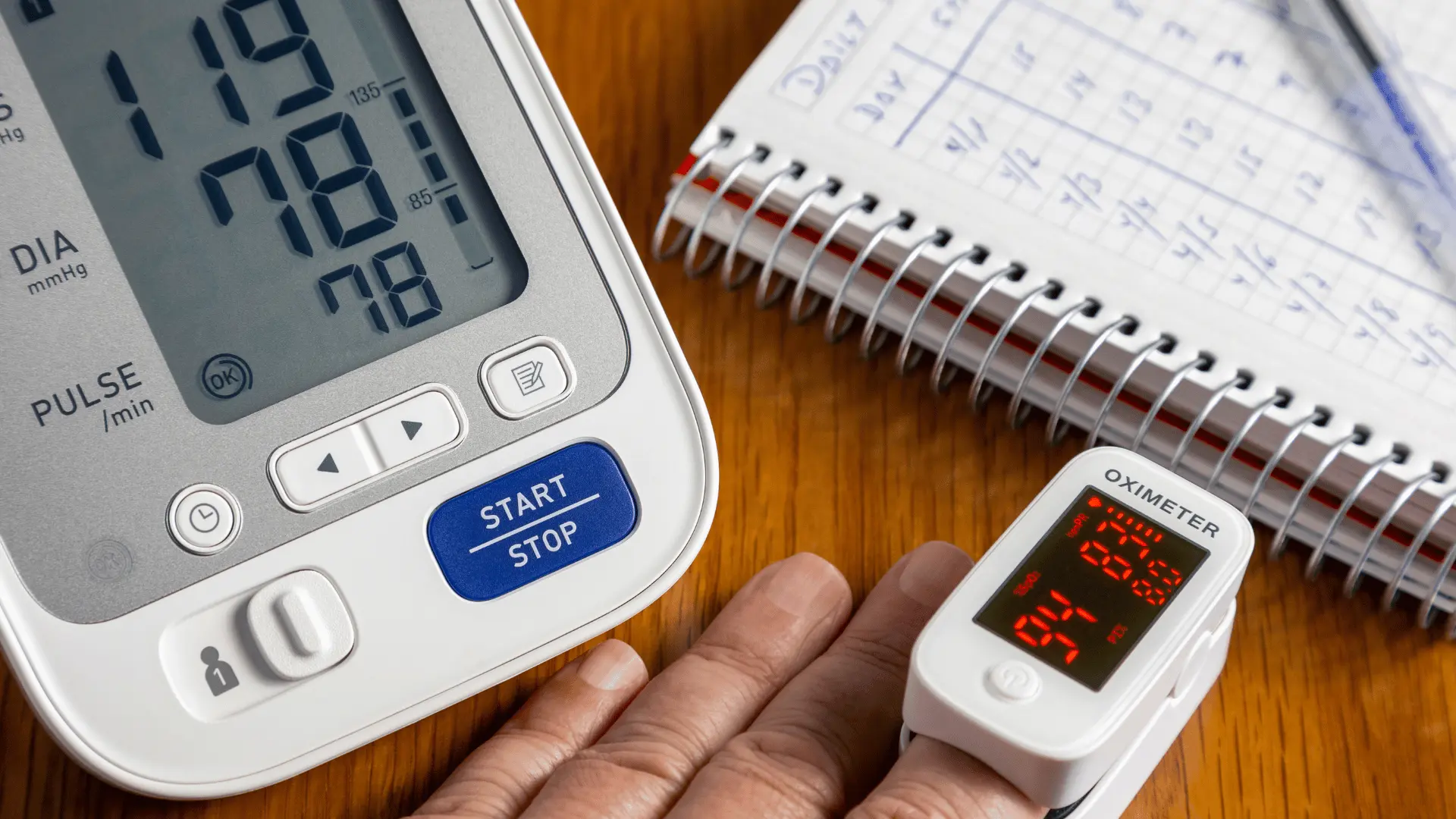
- This is a one-time billable code per patient per device setup.
- Requires at least 16 days of device usage in a 30-day period for billing.
- Devices must meet FDA medical device criteria and automatically transmit data to the care team.
CPT 99453 Reimbursement
Average national reimbursement: $19.73.
*Reimbursement rates are based on a national average and may vary depending on your location. Check the Physician Fee Schedule 2025 for the latest information.
CPT Code 99454
This code covers the supply of RPM devices, ongoing data collection, transmission, and monitoring of patient data during a 30-day period.
Billing Requirements for 99454:
- Billable once per patient every 30 days, regardless of how many devices are used.
- A minimum of 16 days of data collection is required in the 30-day period.
- Devices must be connected and capable of transmitting data automatically.
CPT 99454 Reimbursement
Average national reimbursement: $43.02.
*Reimbursement rates are based on a national average and may vary depending on your location. Check the Physician Fee Schedule 2025 for the latest information.
CPT Code 99457
CPT 99457 is used for the first 20 minutes of remote patient monitoring and management. This includes direct, live, interactive communication with the patient or caregiver (via phone, video, or other digital means).
Billing Requirements for 99457

- Requires a minimum of 20 minutes of clinical staff, physician, or other qualified healthcare provider time in a given 30-day billing period.
- Must involve real-time communication, ensuring personalized care.
- Includes the review of patient data and development of care plans.
CPT 99457 Reimbursement
Average national reimbursement: $47.87.
*Reimbursement rates are based on a national average and may vary depending on your location. Check the Physician Fee Schedule 2025 for the latest information.
CPT Code 99458
CPT 99458 is an add-on code for additional increments of 20 minutes of RPM management during the same 30-day period as CPT 99457.
Billing Requirements for 99458
- Billable for each additional 20 minutes of patient monitoring and management beyond the initial 20 minutes billed under 99457.
- Requires live, interactive communication with the patient or caregiver.
- Can be billed multiple times as long as time thresholds are met.
CPT 99458 Reimbursement
Average national reimbursement: $38.49.
*Reimbursement rates are based on a national average and may vary depending on your location. Check the Physician Fee Schedule 2025 for the latest information.
CPT Code 99091
CPT 99091 is used to bill for the collection and review of patient-generated health data (PGHD) by a physician or other qualified healthcare professional. Unlike other RPM codes, this code specifically requires direct involvement by a physician or qualified healthcare provider to interpret data and provide feedback to the patient.
- Requires a minimum of 30 minutes of provider time in a 30-day period to review and analyze remotely collected data and communicate findings to the patient.
- Can only be billed once per 30-day billing cycle.
- The patient must provide prior consent for RPM services, and this must be documented in their medical record.
- Time spent under 99091 cannot overlap with time reported under other RPM codes (e.g., 99457 or 99458).
CPT 99091 Reimbursement
Average national reimbursement: $51.75.
*Reimbursement rates are based on a national average and may vary depending on your location. Check the Physician Fee Schedule 2025 for the latest information.
Key Distinction
Unlike other RPM codes (99457, 99458), which allow billing for care team members under general supervision, CPT 99091 specifically requires direct physician or qualified healthcare professional involvement in data review and patient feedback.
Things to Avoid While Billing RPM
Proper billing is crucial to ensure compliance and maximize reimbursement for Remote Patient Monitoring (RPM) services. Here are common mistakes to avoid:
Billing Without Patient Consent – Always obtain and document patient consent before initiating RPM services.

Insufficient Data Collection – Ensure the patient transmits at least 16 days of data per 30-day period to meet CMS requirements.
Incorrect CPT Code Usage – Use appropriate CPT codes (e.g., 99453, 99454, 99457, 99458) based on service duration and type.
Duplicate Billing – RPM services should not be billed alongside other overlapping services like Chronic Care Management (CCM) unless properly justified.
Lack of Provider Supervision – Clinical staff time must be under direct or general supervision as required for billing.
Failure to Document Services – Keep thorough records of device usage, patient interactions, and clinical interventions to avoid claim denials.
Improve Patient Outcomes with Humhealth’s Advanced Remote Patient Monitoring
Remote Patient Monitoring (RPM) enables healthcare providers to track patient health in real-time using advanced telehealth solutions. Humhealth seamlessly integrates with RPM devices like blood pressure monitors, providing instant access to vital signs and health data. This proactive approach ensures early detection of health concerns and timely interventions, leading to improved patient outcomes and better chronic disease management.
References
Related Articles
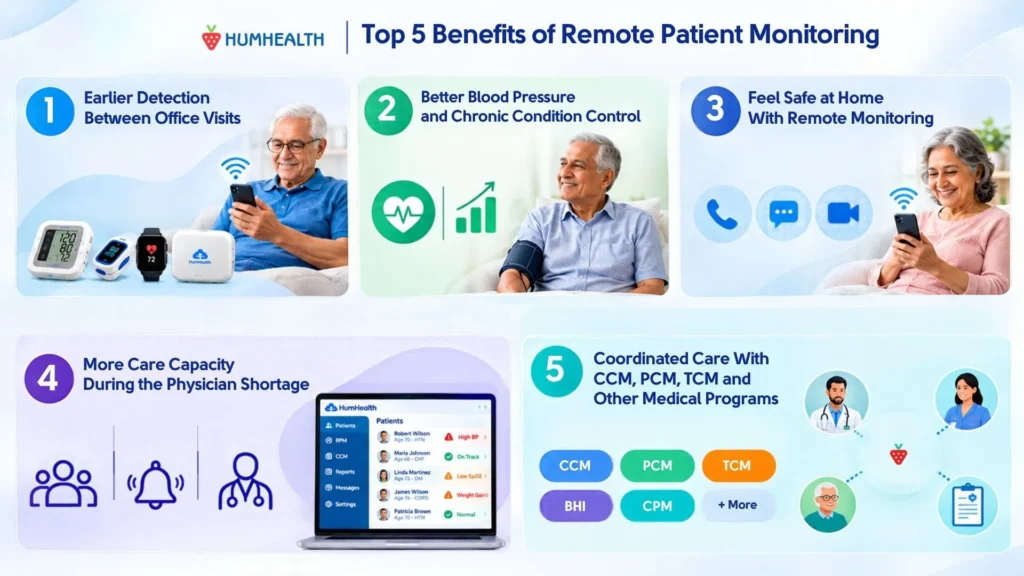
5 Benefits of Remote Patient Monitoring for Patients and Practices
The five main benefits of remote patient monitoring (RPM) are: 1. Earlier detection of health changes between office visits 2. Better blood…
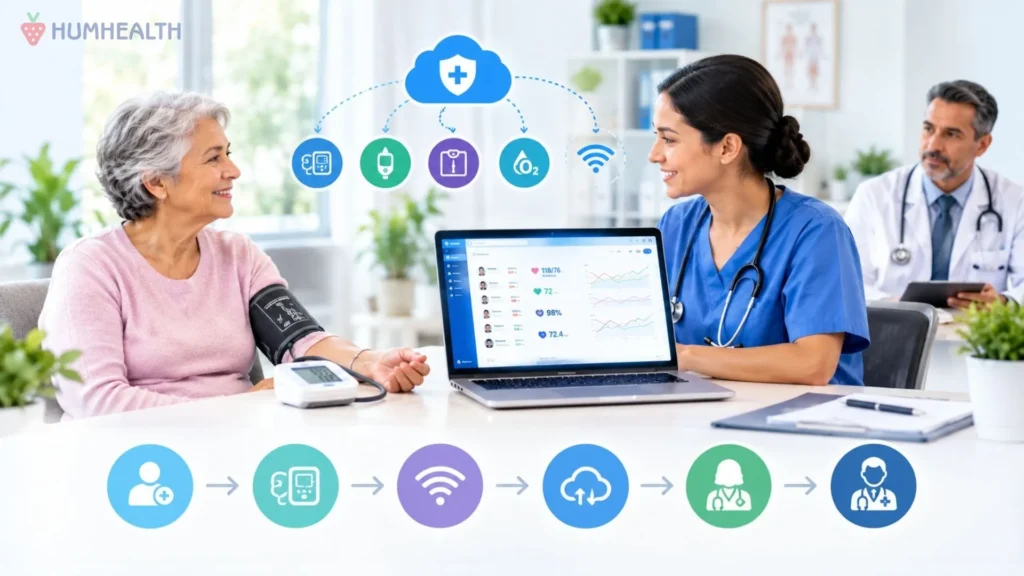
Remote Patient Monitoring for Independent Practices
Independent practices are built on long-standing patient relationships, direct physician involvement, and the ability to make operational decisions quickly. Those same qualities…
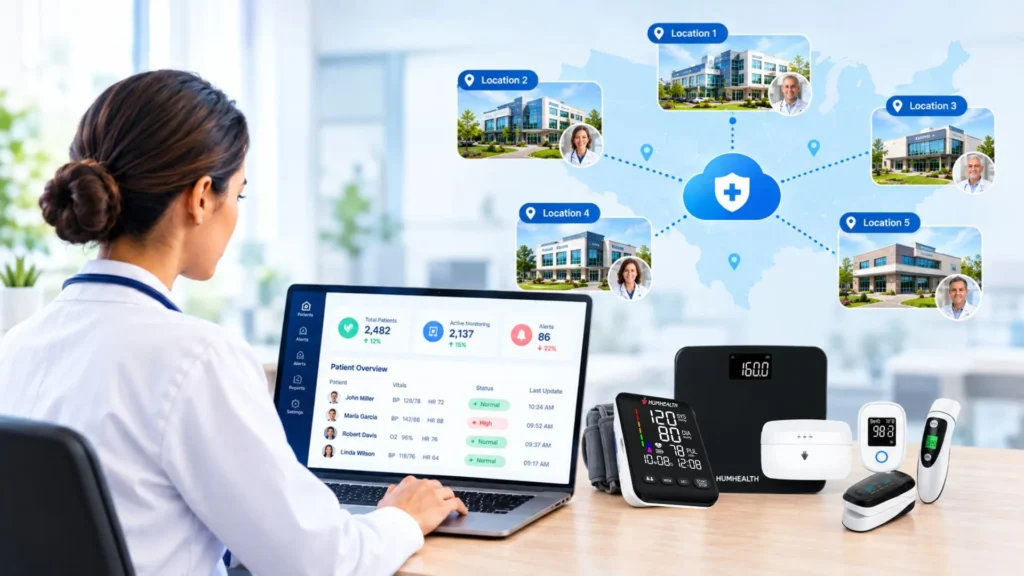
How Large Practices Can Launch Remote Patient Monitoring at Scale
A remote patient monitoring program that works well in a single clinic does not automatically work at a health system with a…