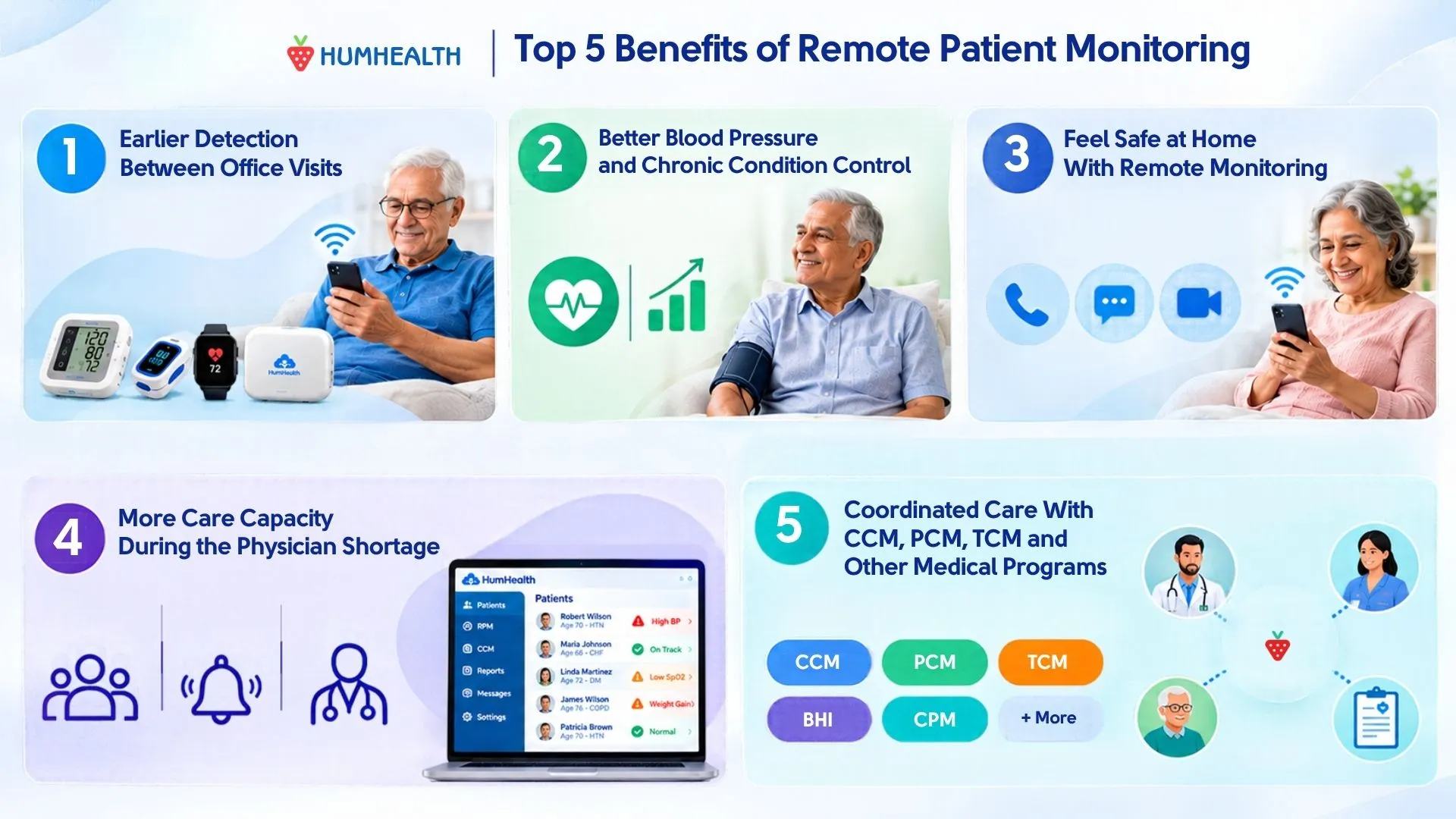
The five main benefits of remote patient monitoring (RPM) are:
- 1. Earlier detection of health changes between office visits
- 2. Better blood pressure and chronic condition control
- 3. Patients feel safe at home because their care team is monitoring them
- 4. More care capacity for practices during the physician shortage
- 5. Coordinated care with CCM, PCM, TCM, and other Medicare programs
Benefits one through three improve patient care, while four and five support medical practices. All five stem from the same change: blood pressure, glucose, weight, and oxygen readings taken at home automatically travel to the care team, so clinicians see how patients are doing between visits instead of only during them. Each benefit below is supported by federal data or peer-reviewed research.
The Growing Need for Remote Patient Monitoring
Rising rates of chronic disease and a growing physician shortage make remote monitoring a practical part of primary and specialty care.
On the chronic disease side, the CDC reports that 90% of the nation’s $5.3 trillion in annual health care spending goes to people with chronic and mental health conditions. More than 40.1 million Americans have diabetes, and heart disease and stroke caused more than 850,000 deaths in 2024 (CDC Chronic Disease Fast Facts). These conditions change day to day, while most patients see a clinician only a few times a year.
On the workforce side, HRSA’s National Center for Health Workforce Analysis projects a shortage of 141,160 physicians in 2038, including 70,610 primary care physicians. Nonmetro areas are projected to face a 58% physician shortage, compared with 5% in metro areas (HRSA Health Workforce Projections).
Medicare adoption reflects both pressures. The HHS Office of Inspector General found that slightly more than 570,000 Medicare enrollees received RPM in 2022, compared with about 55,000 in 2019. In 2022, 94% of those enrollees were monitored for chronic conditions, and more than half were monitored for hypertension (HHS OIG, OEI-02-23-00260). The OIG also noted that more than 60% of Medicare enrollees have hypertension, yet only a small fraction currently receive RPM, which points to continued growth for the program.
How Remote Patient Monitoring Works
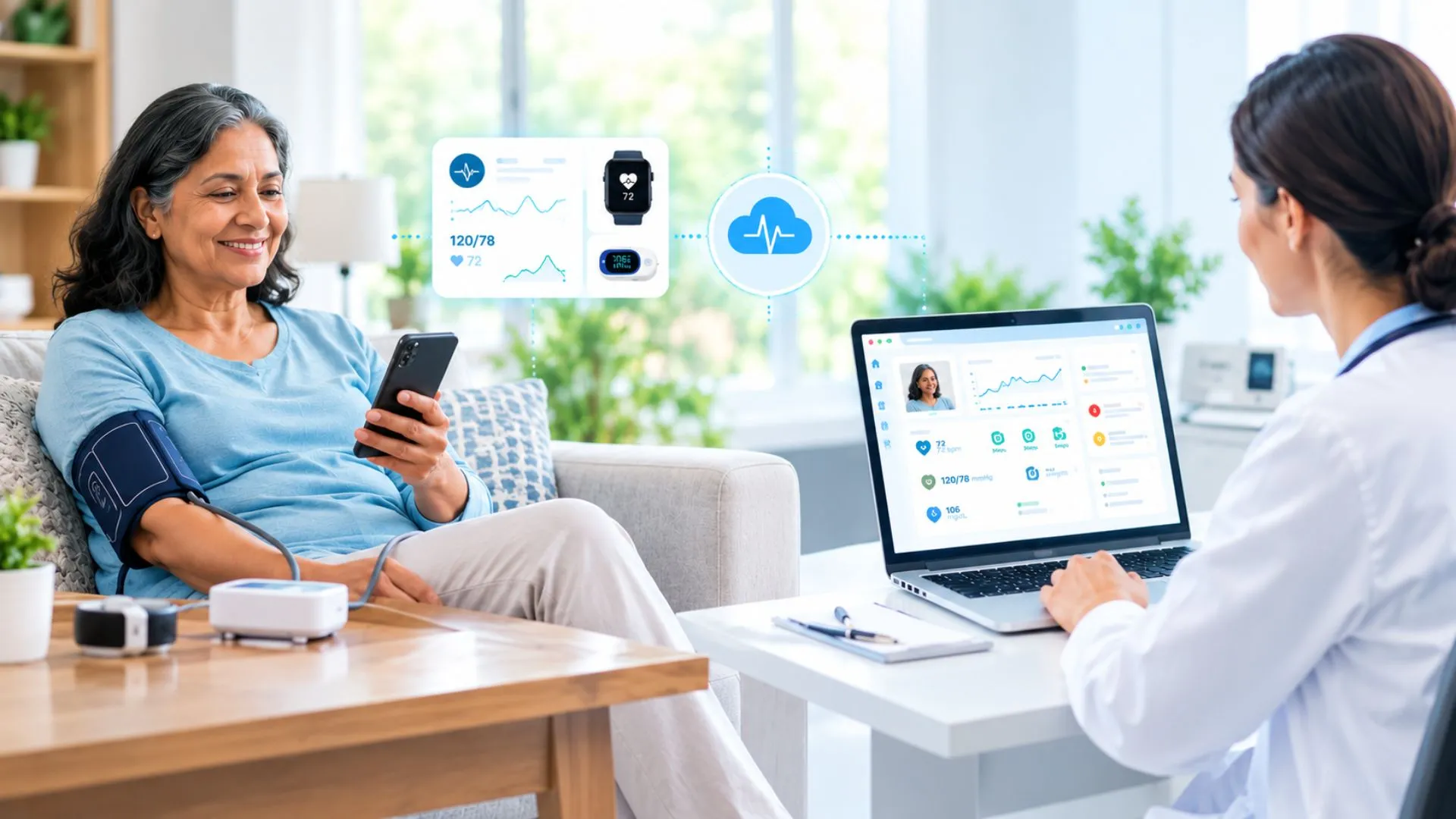
CMS describes remote monitoring as a patient collecting their own health data, such as blood pressure, with a connected medical device that automatically transmits the data to their provider, who then uses it to treat or manage the patient’s condition (CMS MLN901705, December 2025). The same booklet breaks the service into three components, each building on the one before it:
- 1. Patient education and device setup, so the patient knows how to use the device and collect accurate readings.
- 2. Device supply, including connecting the device and setting how often the patient should take readings.
- 3. Treatment management, where the care team reviews the data and acts on it to improve the patient’s health.
The third component is where most of the value sits. Readings alone do not change outcomes; a clinician reviewing trends and talking with the patient does. Practices can see this workflow in the HumHealth RPM platform, which supports Bluetooth devices, 4G cellular devices, and a 4G gateway hub for patients without smartphones.
Top 5 Benefits of Remote Patient Monitoring
Benefits 1 through 3 describe what patients gain from RPM. Benefits 4 and 5 describe how RPM supports the practice and its broader care management program.
1. RPM Benefits for Patients: Earlier Detection Between Office Visits
A weight gain of a few pounds in a heart failure patient, or a run of high morning blood pressure readings, can signal a problem days before symptoms bring the patient in. RPM puts those readings in front of the care team as they happen, so outreach can start while the change is still small.
The research on heart failure shows what this looks like at scale. A Cochrane systematic review found that non-invasive home telemonitoring reduced heart failure-related hospitalizations (risk ratio 0.71, 8 studies, 2,148 participants) and all-cause mortality (risk ratio 0.80, 17 studies, 3,740 participants), both rated moderate-quality evidence (Inglis et al., Cochrane Database of Systematic Reviews). Threshold alerts make this practical for a busy team because staff review readings that fall outside each patient’s set range first.
2. RPM Benefits for Patients: Better Blood Pressure and Chronic Condition Control
RPM helps patients keep chronic conditions in range, and evidence shows the care team is what drives the result. An individual patient data meta-analysis of randomized trials found that home blood pressure self-monitoring alone produced no significant change at 12 months (minus 1.0 mmHg systolic). When monitoring was paired with intensive clinician support, systolic blood pressure fell by 6.1 mmHg (Tucker et al., PLOS Medicine).
That finding matches how Medicare structures the service. Treatment management, the step where clinical staff review data and talk with the patient, is a separately defined component of RPM, not an optional extra. Practices that build consistent outreach into the workflow, as covered in our guide on how to keep patients engaged in remote patient monitoring programs, are the ones that turn readings into better control.
3. RPM Benefits for Patients: Feeling Safe at Home With Remote Monitoring
For many older adults and people living with chronic illness, the hardest part of managing a condition at home is the uncertainty between visits. RPM changes that experience. Patients know that each reading reaches their care team and that someone will reach out if a number looks wrong.
A qualitative study of patients and clinicians using home telemonitoring for chronic conditions found that a sense of security came from having someone keep track of symptoms, along with clear availability of the care team, shared responsibility, confidence in the technology, and support for self-management (Ekstedt et al., BMC Health Services Research). Practical details support that confidence: automated reminders when a reading is missed, simple devices that work without a smartphone, and two-way communication by text, phone, or video. The result is a patient who can stay in their own home, reassured by remote monitoring from people who know their history.
4. RPM Benefits for Practices: More Care Capacity During the Physician Shortage
With HRSA projecting a shortage of over 70,000 primary care physicians in 2038 (HRSA), practices need ways to support more patients without adding visits. RPM extends care team reach in two ways. Readings arrive in one dashboard instead of through scattered calls, and alerts direct attention to the patients who need it that day.
Under current 2026 rules, CMS allows auxiliary personnel to provide remote monitoring services under the general supervision of the billing practitioner (CMS MLN901705). That lets nurses and medical assistants handle routine review and outreach while physicians focus on clinical decisions. The value is greatest in rural communities, where HRSA projects the deepest physician shortages, and patients often travel long distances for a routine check.
5. RPM Benefits for Practices: Coordinated Care With CCM, PCM, TCM, and Other Medicare Programs
RPM rarely works best on its own. CMS states that remote physiologic monitoring may be billed concurrently with chronic care management, transitional care management, behavioral health integration, principal care management, and chronic pain management for the same patient, as long as time and effort are not counted twice (CMS MLN901705). Remote physiologic monitoring and remote therapeutic monitoring cannot be billed together.
This is where RPM supports both care quality and program stability. A patient with hypertension and diabetes might receive RPM for daily readings, chronic care management for care planning and medication review, and transitional care management after a hospital discharge. A specialist managing one complex condition might pair RPM with principal care management. Each service has its own requirements and documentation, and together they give the practice a steady monthly structure for staffing ongoing care management rather than relying on one service alone. Our article on why practices provide CCM with RPM walks through this pairing in more detail.
The 2026 Physician Fee Schedule also made RPM easier to fit to each patient. CMS now recognizes device supply for 2 to 15 days of data in a 30-day period, in addition to the 16-day threshold, through new CPT code 99445, along with CPT 99470 for the first 10 minutes of treatment management (CY 2026 PFS final rule, Federal Register). Patients who need lighter monitoring can now stay in the program, which supports continuity of care.
RPM rules continue to evolve, so practices should plan with the next rule cycle in mind. In the CY 2027 Physician Fee Schedule proposed rule, CMS proposed requiring a separately reportable initiating visit when RPM begins, paying for RPM only when it is performed by clinical staff employed by the practice rather than by contractors, and revaluing remote monitoring services. CMS also sought comment on bundling the RPM and RTM CPT codes into four new HCPCS G-codes (CMS CY 2027 PFS proposed rule fact sheet). These are proposals, not current requirements, and would take effect on January 1, 2027 only if finalized. Our summary of the CMS 2027 proposed rule covers the details.
How HumHealth Supports Remote Patient Monitoring Programs
HumHealth is built to turn the five benefits above into a daily workflow that a practice’s existing care team can run.
For earlier detection, each patient gets threshold ranges for their readings, and any value outside that range alerts the care team. Staff start the day with the patients who need attention instead of scanning every reading by hand.
For consistent data, automated text reminders are sent when a patient misses a reading, and the platform tracks reading compliance across the month. That keeps the clinical picture complete and shows staff early which patients need help staying on track.
For patient confidence at home, practices can match the device to the patient: FDA-cleared Bluetooth devices with the HumHealth mobile app, Bluetooth devices with a shared 4G gateway for the household, or 4G cellular devices that need no smartphone or Wi-Fi. The care team can reach patients by text, voice call, or video call from the same workspace.
To reduce manual work, an automatic timer records monitoring and patient communication time, and the software keeps RPM time separate from CCM time. Staff spend less time on manual logs, and documentation is ready when RPM runs alongside other programs.
For coordinated care, HumHealth supports CCM, PCM, TCM, BHI, CPM, and other Medicare care management programs, so patients enrolled in more than one service are managed in one place.
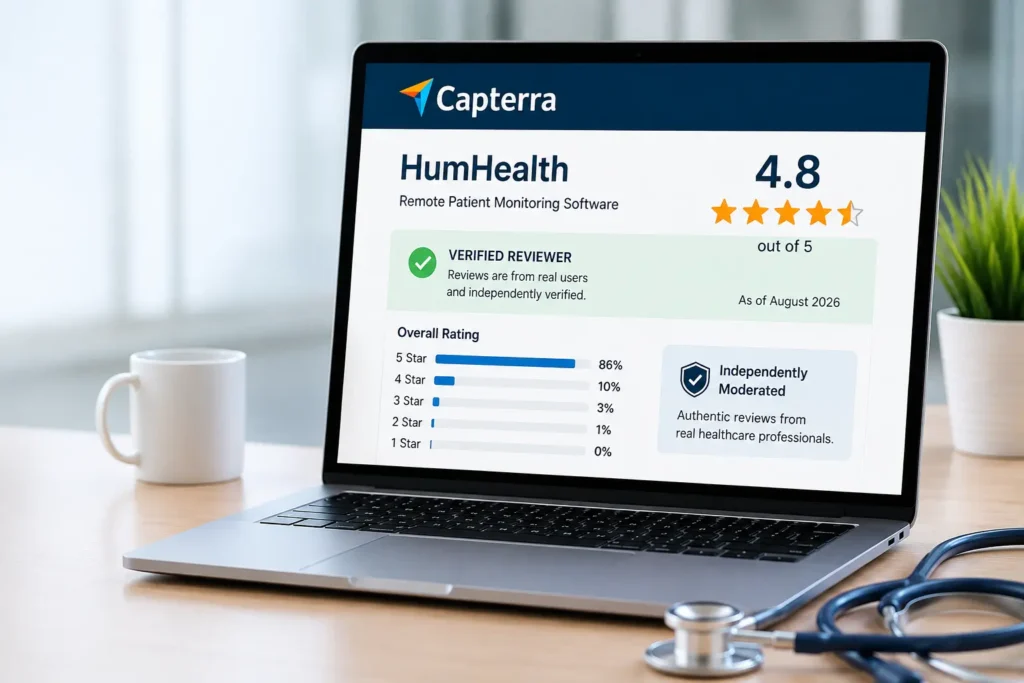
HumHealth is 4.8-star rated by real, verified users on Capterra, and RPM pricing starts at just $3 per patient per month on a month-to-month contract.
Conclusion
The benefits of remote patient monitoring come from one simple change: the care team sees how patients are doing every day, not only on visit days. For patients, that means earlier attention to warning signs, better control of conditions like hypertension, and the confidence of being cared for at home. For practices, it means more reach during a physician shortage and a monitoring service that fits alongside other Medicare programs.
If you are ready to start an RPM program or bring more of your chronic care patients into one, book a HumHealth demo. You will see the full workflow in action, from device setup and threshold alerts to automatic time tracking and billing reports, and how it fits alongside the CCM and PCM programs you may already run. Prefer to explore on your own first? Start a free trial or review the HumHealth remote patient monitoring platform.
Related Articles
Frequently Asked Questions
The five main benefits of remote patient monitoring are earlier detection of health changes between visits, better control of chronic conditions such as hypertension, a stronger sense of safety for patients at home, more care capacity during the physician shortage, and coordinated care with other Medicare programs such as CCM, PCM, and TCM.
Patients feel safer because their readings reach the care team automatically and someone follows up when a value falls outside their range. Research on home telemonitoring links this sense of security to the care team’s availability, shared responsibility, confidence in the devices, and support for self-management (BMC Health Services Research).
Medicare covers RPM for patients with an acute or chronic condition who have an established relationship with the billing practitioner (CMS MLN901705). In 2022, more than half of Medicare RPM enrollees were monitored for hypertension, followed by diabetes (HHS OIG). Patients with heart failure, COPD, and chronic kidney disease are also commonly monitored.
Yes. CMS allows remote physiologic monitoring to be billed concurrently with chronic care management, transitional care management, behavioral health integration, principal care management, and chronic pain management for the same patient, provided time and effort are not counted twice. RPM and remote therapeutic monitoring cannot be billed together (CMS MLN901705).
RPM lets a care team follow more patients without adding office visits. Readings arrive in one place, alerts flag the patients who need attention, and auxiliary personnel can provide monitoring services under the general supervision of the billing practitioner. HRSA projects a shortage of 70,610 primary care physicians in 2038 (HRSA).
The CY 2026 Physician Fee Schedule added CPT 99445 for device supply with 2 to 15 days of data in a 30-day period and CPT 99470 for the first 10 minutes of treatment management. Practices bill either 99445 or 99454 for device supply, depending on the number of days with data (CY 2026 PFS final rule).
Possibly. The CY 2027 Physician Fee Schedule proposed rule would require a separately reportable initiating visit when RPM begins, pay for RPM only when it is performed by clinical staff employed by the practice, and revalue remote monitoring services. CMS also sought comment on bundling RPM and RTM codes into four new HCPCS G-codes. These are proposals, not current requirements, and would apply from January 1, 2027 only if finalized (CMS fact sheet).
Related Articles
Remote Patient Monitoring for Independent Practices
Independent practices are built on long-standing patient relationships, direct physician involvement, and the ability to make operational decisions quickly. Those same qualities…
How Large Practices Can Launch Remote Patient Monitoring at Scale
A remote patient monitoring program that works well in a single clinic does not automatically work at a health system with a…
How to Evaluate Remote Patient Monitoring Software: What Real Capterra Reviews Show
If you're researching the best remote patient monitoring software in 2026, you've probably seen plenty of comparison articles, feature lists, and vendor…