Remote patient monitoring software only delivers value for a practice if patients keep transmitting data consistently. Medicare requires at least 16 days of transmitted data in a rolling 30-day period to bill the standard device-supply code built into most remote patient monitoring software workflows, and while there’s now a partial fallback as of the 2026 Medicare Physician Fee Schedule (a new code covering 2–15 days), drop below even that and there’s nothing to bill at all. Getting a patient enrolled in an RPM program is the easy part. Keeping them engaged for months at a time is what actually determines whether remote patient monitoring software delivers on its outcomes and its revenue.
Most conversations about remote patient monitoring software focus on setup: choosing devices, understanding CPT codes, getting a program live. Far less is written about what happens in month three or four, when the initial novelty wears off and engagement starts quietly sliding. Published research on remote monitoring programs puts dropout rates anywhere from under 10% to nearly 80%, depending heavily on how well the program is run, and how effectively the remote patient monitoring software supports it, rather than the condition being monitored, which means engagement is largely something a practice can influence, not a fixed cost of doing RPM. This post is about that stage: what keeps patients engaged in an RPM program, and where engagement typically breaks down.
What Actually Keeps Patients Engaged in Remote Patient Monitoring Programs
Enrollment should be treated as a conversation rather than a form to sign. Patients who understand specifically what their readings will be used for, and what happens if a number is out of range, tend to stay engaged in the program far longer than patients who were simply handed a device. This is also where documented, informed consent should take place, which supports both retention and billing compliance within the practice’s remote patient monitoring software.
The device itself should be matched to the patient rather than the reverse. Cellular-connected devices that require no app, no Wi-Fi, and no smartphone pairing remove the most common failure point for older or less tech-comfortable patients. Where BYOD or app-based monitoring is used instead, practices should budget additional onboarding time and maintain a clear troubleshooting path within their remote patient monitoring software.
The monthly interactive communication CMS already requires for billing should be made visible to the patient, not treated purely as a compliance step. A short, scheduled call that references the patient’s actual data, pulled directly from the remote patient monitoring software, reinforces that someone is paying attention, and this is often the single largest driver of continued engagement. The effect is measurable: a peer-reviewed study of Medicaid patients on RPM for diabetes found that a single adherence reminder call raised the average transmission rate among previously nonadherent patients from 45.9% to 60.2%, a substantially larger lift than the same call produced among patients who were already engaged.
A re-engagement workflow is as important as the enrollment workflow. Patients should be flagged inside the remote patient monitoring software after a defined number of missed transmission days, not at the end of the billing cycle, with a clear next step such as a call, a text, or a caregiver contact. Recovering a lapsed patient in week two is a far simpler problem than recovering one after twenty missed days.
Alert thresholds within the remote patient monitoring software should be tuned to reduce noise. Overly sensitive escalation criteria bury the readings that matter clinically and consume staff capacity that would otherwise go toward outreach, which in turn keeps patients engaged.
Caregivers should be identified and included early, particularly for patients managing cognitive decline, mobility limits, or several chronic conditions. Where a spouse or adult child is handling device setup or daily reminders, that person should also receive alerts and reminders directly from the remote patient monitoring software.
Engagement should be tracked as its own metric inside the remote patient monitoring software, separate from enrollment totals. Practices that monitor day-30 and day-90 active-transmission rates by patient catch disengagement early enough to intervene, rather than discovering it once a billing cycle has already fallen short.
Where Engagement Typically Breaks Down in Remote Patient Monitoring Programs
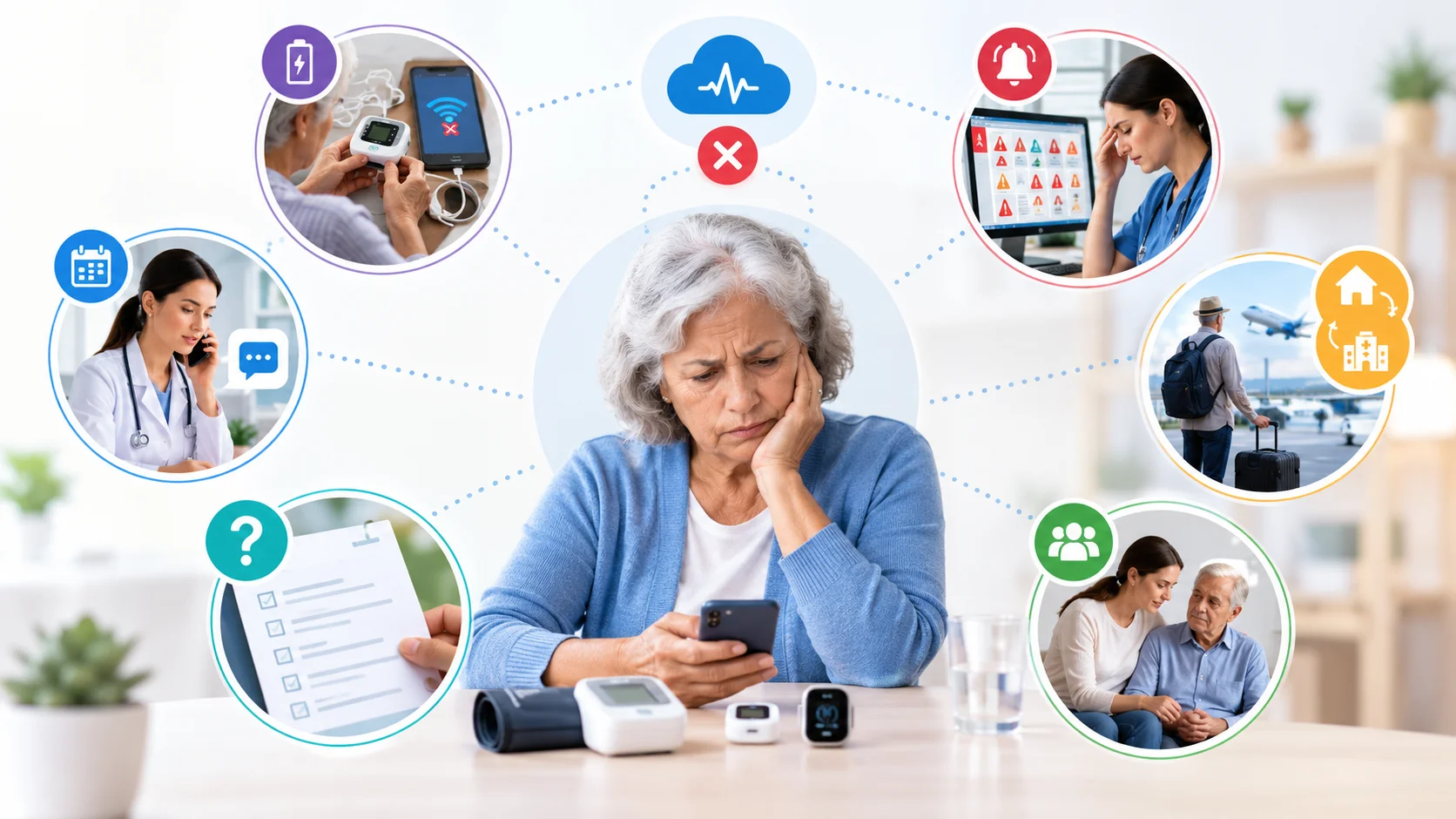
Most disengagement can be traced to a small number of recurring patterns. Device friction is the most common: patients abandon monitoring when the device connected to the practice’s remote patient monitoring software is confusing, requires a Wi-Fi or app setup they can’t manage, or needs charging they forget about. Older patients, who make up most of the RPM population, are disproportionately affected by any added technical step.
A second pattern is the absence of visible follow-up. If a patient transmits data through remote patient monitoring software for weeks without hearing from their care team, the program starts to feel pointless, and engagement drops accordingly. Related to this is unclear expectations at enrollment: patients who were not given a clear explanation of what their data is used for often don’t understand why they’re participating, and rushed consent at enrollment tends to predict disengagement later.
Alert fatigue on the clinical side has a similar downstream effect. When care teams are flooded with low-value alerts generated by remote patient monitoring software, monitoring and outreach slip, and patients notice when follow-up calls stop happening.
Life disruption is a further factor. Travel, hospitalization, a change in living situation, or a caregiver stepping back can interrupt a patient’s participation in the program, disrupting the data flow into the practice’s remote patient monitoring software even for previously engaged patients. Programs without a re-engagement process tend to treat this as attrition rather than as a recoverable gap.
Finally, a lack of caregiver involvement is often an unaddressed single point of failure. For patients with cognitive decline, mobility limits, or multiple chronic conditions, day-to-day management of the device tied to the remote patient monitoring software frequently depends on a spouse or adult child who was never looped into the program.
The Revenue Case for Staying Engaged in Remote Patient Monitoring Programs
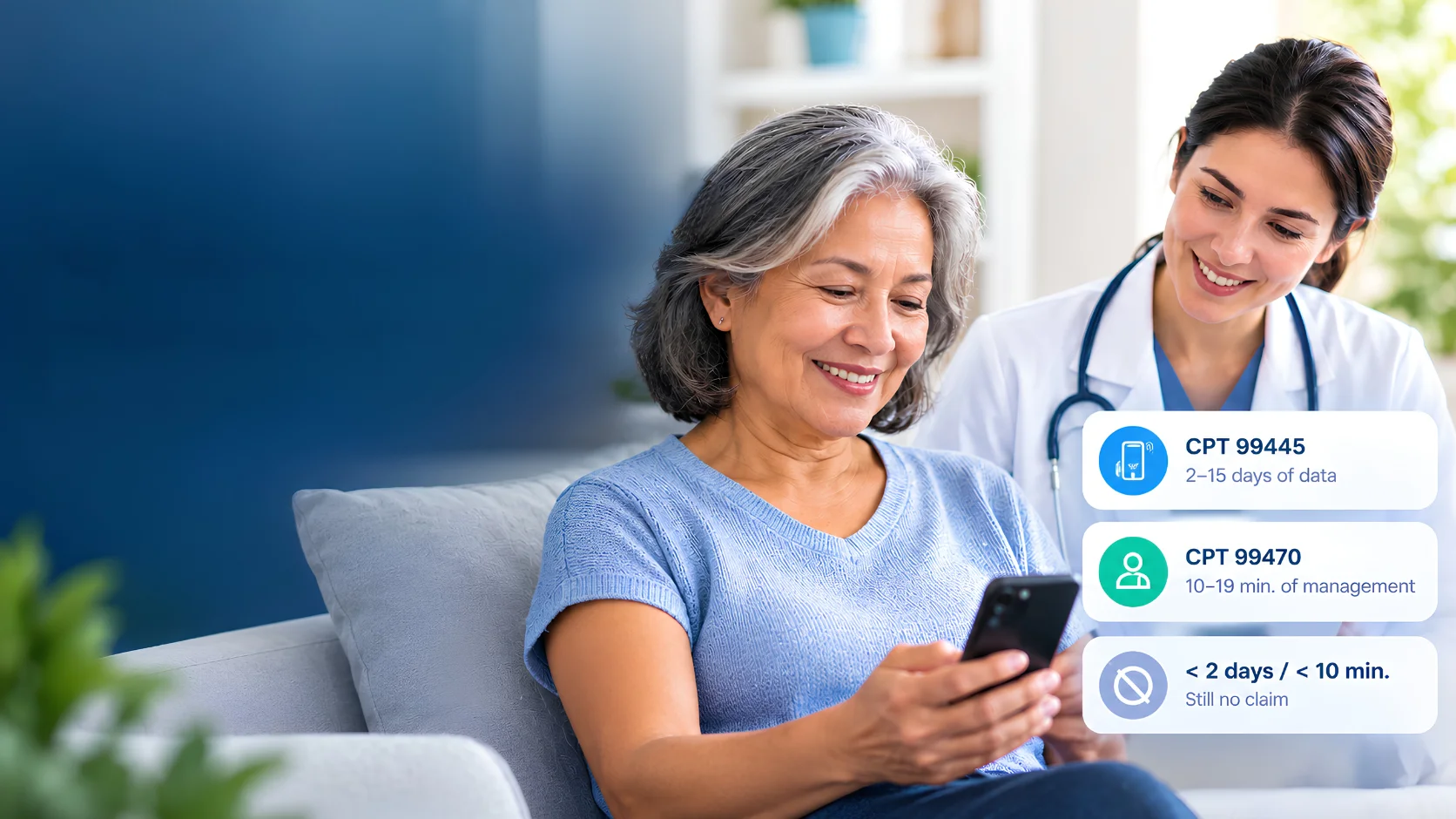
It’s worth being precise about what falling short of full engagement actually costs, because the math changed in 2026. The Medicare Physician Fee Schedule finalized that year added two codes that soften the all-or-nothing thresholds built into most remote patient monitoring software billing workflows. CPT 99445 covers device supply and data transmission for patients who transmit 2–15 days of data in a 30-day period, closing the gap previously left uncompensated below the 16-day threshold required for CPT 99454, and reimburses, since CMS noted the cost of supplying the device doesn’t change based on how many days it was used. On the management side, CPT 99470 covers the first 10–19 minutes of RPM management time per month, versus the full 20 minutes required for CPT 99457; a practice bills one or the other depending on the time actually reached that month, never both.
So a patient who falls short of full engagement isn’t necessarily a lost claim anymore, on either the device or the management side, but a patient who falls below even 2 days of transmission, or under 10 minutes of real management time, still generates nothing. A practice with strong enrollment numbers but weak engagement can still look healthy on paper in its remote patient monitoring software reports while quietly losing meaningful revenue, just not as sharply as before the 2026 code changes. Sustained engagement, not just enrollment, is still what determines whether an RPM program run on remote patient monitoring software is fully profitable rather than partially profitable. For a deeper look at the cost and revenue side of running a program, see our guide to RPM cost and ROI.
Other Articles
Frequently Asked Questions
Clear enrollment conversations, a device matched to the patient’s comfort level, visible monthly check-ins tied to their actual data, and an active outreach workflow inside the remote patient monitoring software for anyone who lapses are the factors that keep engagement steady past the first few weeks.
Sixteen days within a rolling 30-day period is required to bill the standard device-supply code, CPT 99454, in most remote patient monitoring software. As of the 2026 Medicare Physician Fee Schedule, a separate code (99445) covers 2–15 days at the same reimbursement rate, though a patient still needs at least 2 days of transmission to bill anything at all.
Partially. CPT 99445, finalized in the 2026 Medicare Physician Fee Schedule, reimburses device supply and data transmission for patients who transmit 2–15 days of data in a 30-day period, at the same rate as the 16-day code, 99454. Management codes still depend on actual time spent with the patient, so engagement below that still reduces revenue even when device-supply billing is covered.
Yes. CPT 99470, also finalized in the 2026 Medicare Physician Fee Schedule, covers 10–19 minutes of RPM management time per month, versus the full 20 minutes required for CPT 99457. A practice bills whichever single code matches the time actually reached that month, and the two aren’t billed together.
The data backs it up. A peer-reviewed study of Medicaid patients using remote patient monitoring for diabetes found that a single adherence reminder call, logged through the practice’s remote patient monitoring software, raised average transmission rates among previously nonadherent patients from 45.9% to 60.2%, a far larger effect than the same call had on patients who were already engaged.
Device friction and a lack of visible follow-up are the two most common drivers. Patients disengage fastest when the device is hard to use or when they never hear from their care team about the data flowing into the remote patient monitoring software.
Yes. As long as the patient remains established with the provider, a short gap in transmission doesn’t require a new enrollment, but practices need a workflow inside their remote patient monitoring software to identify and reach out to lapsed patients quickly, or the gap tends to become permanent.
For patients who depend on family support for daily device use, yes. Building the caregiver into onboarding and alerts within the remote patient monitoring software removes a common single point of failure in the monitoring routine.
Related Articles
CCM After TCM: How to Keep Patients Supported Beyond the 30-Day Transition Period
A hospital discharge is the end of an inpatient stay, but it’s not the end of a patient’s care needs. Diabetes, heart…
Chronic Care Management and Annual Wellness Visit: How They Connect in Ongoing Patient Care
Chronic care management (CCM) and annual wellness visit (AWV) programs work best as one connected system, not two separate services. The AWV…

Do Care Management Programs Really Benefit Patients? What the Evidence Shows
Do care management programs really benefit patients? Research and CMS program data suggest they do. Patients in these programs get a personal…