What is Advanced Primary Care Management (APCM)?
Advanced Primary Care Management (APCM) is a Medicare program specifically designed to provide continuous, personalized care to patients. This innovative approach to healthcare management is centered on the principles of preventive care, holistic patient support, and dedicated care teams. APCM focuses on preventive care management of chronic diseases.
Advanced Primary Care Management incorporates elements of other care management programs, like Chronic Care Management, Transitional Care Management, and Principal Care Management. However, Advanced Primary Care Management is available to all Medicare patients regardless of their number of chronic conditions.

Key Benefits of APCM
For Patients

Improved Care Coordination

Better Management of Chronic Conditions

Timely diagnosis and treatment

Improved Patient Outcomes
For Providers

Optimized Practice Workflows

Focus on Value-Based Care

Financial benefits for providers

Risk-Stratified Reimbursement
How APCM is different from CCM and PCM?

Risk-Based Reimbursement, Not Time-Based

No Minimum Time Requirement

Broader Eligibility Beyond Chronic Conditions

Participation in quality measurement
APCM Risk-Based Levels
Level 1: HCPCS G0556
APCM services for a patient with one chronic condition (expected to last at least 12 months or until death, posing a significant risk of severe health decline) or no chronic condition. Services are provided by clinical staff under the direction of a physician or qualified healthcare professional who oversees primary care and acts as the patient’s central point of contact for all healthcare needs.
Level 2: HCPCS G0557
APCM services for patients with two or more chronic conditions that are expected to last at least 12 months or until death and pose a significant risk of severe health deterioration, including death, acute exacerbation, or functional decline. This code includes all foundational care management elements and expands upon them to ensure comprehensive, ongoing patient support.
Level 3: HCPCS G0558
APCM services for Qualified Medicare Beneficiaries (QMBs) with two or more chronic conditions that are expected to last at least 12 months or until death and pose a significant risk of severe health deterioration, including death, acute exacerbation, or functional decline. Services are provided by clinical staff under the direction of a physician or qualified healthcare professional who oversees primary care and serves as the central point of coordination for all necessary healthcare services.
Elements of APCM
- Patient Consent
- Initiating Visit
- 24/7 Access
- Continuity of Care
- Patient- Centered Care Delivery
- Comprehensive Care Management
- Comprehensive and Electronic Care Plan
- Care Transition Coordination
- Practitioner, Home, and Community Coordination
- Enhanced Communication Methods
- Patient Population Data Management
- Performance Measurement

APCM Workflow in HUMHEALTH

Identify Eligible Patients

Get Patient Consent

Enroll the Patient in APCM

Conduct an Initial Visit for New patients

Provide Comprehensive Care Management

Continuous Monitoring, Evaluation, and Care Plan Adjustment

One-Click Documentation

Timely Reimbursement
Advanced Primary Care Management (APCM) Billing Codes and Average Reimbursement
-
HCPCS Codes
-
Billing code Description
-
Average Reimbursement
-
HCPCS Codes
G0556 (Level 1)
-
Billing code Description
Advanced Primary Care Management (APCM) services for patients with one chronic condition or fewer. Performed by a Physician, Nurse Practitioner (NP), Physician Assistant (PA), or other Qualified Health Care Professional (QHCP). -
Average Reimbursement
$16
-
HCPCS Codes
G0557(Level 2)
-
Billing Code Descriptors
Advanced Primary Care Management (APCM) services for patients with two or more chronic conditions. Performed by a Physician, Nurse Practitioner (NP), Physician Assistant (PA), or other Qualified Health Care Professional (QHCP). -
Average Reimbursement
$54
-
HCPCS Codes
G0558(Level 3)
-
Billing Code Descriptors
Advanced Primary Care Management (APCM) services for patients with multiple chronic conditions who are also Qualified Medicare Beneficiaries (QMBs). Performed by a Physician, Nurse Practitioner (NP), Physician Assistant (PA), or other Qualified Health Care Professional (QHCP). -
Average Reimbursement
$117
-
HCPCS Codes
G0568
-
Billing Code Descriptors
Initial CoCM Services (BHI Add-On)Psychiatric Collaborative Care Management (CoCM), initial month, furnished with APCM service. Includes initial behavioral health assessment, care plan development, registry-based tracking, psychiatric consultant review, and care manager interventions. Performed by a Physician or QHCP directing care, Behavioral Health Care Manager, and Psychiatric Consultant. -
Average Reimbursement
$162
-
HCPCS Codes
G0569
-
Billing Code Descriptors
Subsequent CoCM Services (BHI Add-On)Psychiatric Collaborative Care Management (CoCM), subsequent month, furnished in conjunction with APCM service. Includes ongoing registry tracking, psychiatric consultation, treatment adjustments, outcome monitoring, and relapse prevention planning. Performed by a Physician or QHCP directing care, Behavioral Health Care Manager, and Psychiatric Consultant. -
Average Reimbursement
$146
-
HCPCS Codes
G0570
-
Billing Code Descriptors
General Behavioral Health Integration (BHI) Add-OnGeneral Behavioral Health Integration (BHI), per calendar month, furnished with APCM service. Includes behavioral health assessment or follow-up, care planning, coordination of psychotherapy and/or medication management, and continuity of behavioral health care. Performed by a Physician or Qualified Health Care Professional (QHCP). -
Average Reimbursement
$58
*Disclaimer: This information is for informational purposes only and does not constitute legal, billing, or professional advice. Billing and coding requirements, especially in remote care management, may change or be interpreted differently over time. Always consult a qualified medical billing professional before submitting claims to ensure all requirements are met.
APCM Frequently Asked Questions (FAQs)
- Patient Consent: Obtain and document a written or verbal consent from the patient to participate in APCM services.
- Initiating Visit: Conduct an initiating visit for new patients or those not seen within the past three years.
- 24/7 Access: Ensure patients have 24/7 access to their care team for urgent needs
- Comprehensive Care Management: Provide systematic needs assessments, preventive services, medication reconciliation, and oversight of patient self-management.
- Electronic Care Plan: Develop and maintain a patient-centered comprehensive care plan that is accessible electronically to the care team and the patient.


Blood Pressure Monitor
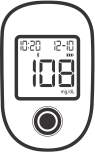
Glucometer

Pulse Oximeter

Weight Scale

4G Gateway (per household)

ECG With BP

Peak Flow Meter

Thermometer